Thoughts
For some reason my phone clears cookies for this site like every time I lock the screen and I have to log in again.
Like, LISP like languages tend to say ‘data are lists and functions are lists everything’s a list’ and they make it easy to change from
data to a function. But in making that transition easy, they emphasize that the transition is necessary.
JavaScript doesn’t let you change from data into a function since from the perspective of the JS programer, functions already are data.
One of the things that I really like about JS is the tendency to treat functions as data. Even other functional languages tend to be worse
about treating functions as operators.
Kind of excited to start a new season here, just a couple of days. I’m thinking about changing up the colors. We’ll see.
I really like the zlib license. I might move to that over the Unlicense for my public domain things.
I do not appreciate the loop macro at all. It’s so ugly to me. If functional code is so good, why do you need DSLs?
Some people understand the power words have. Those people tend to be LISP programmers.
“Agree politely, but delete nothing. Never apologize for who you are.”
I feel like the Hellmouth Sunbeams spend too much time on the “sunbeams” parts and not enough time on the “hellmouth” part send tweet
Just realized that this page has been at this URL for too long and I basically can't ever change it.
I want to eat dinner tonight but it’s unclear if my executive dysfunction will allow me to. Or if I will be trapped here.
All I want is for the Lock Picking Lawyer to actually pick the locks. I don't care that you found a lock at walmart that you can open by
shoving a bent bit of plastic into its keyhole. If he doesn't say "little click out of one," it's not worth my time to watch the video.
I think a lot about the decision to add `let` to JS instead of changing the behavior of `var`. That’s what backwards compatibility looks
like.
I hate this but I don’t see how else to do it. That what I need, is someone to show me the way.
A picture of a whiteboard. Overlapping text in different colors reads as follows.
[Black text, not overlapping anything else:]
No.
I
Who
is. Your friend.
right. Or.
Surrender to the system.
Become more than yourself.
[An untranscribable scribble]
U
Europa.
Somewhere else
Someone else
Has created
And destroyed
More than I will ever see.
[Blue text, sideways, underneath red text:]
Some say
Life is about something.
They miss that life is everything.
This not poetry.
This is prose. An essay.
Of course
[Black text, upside-down, underneath red text:]
Pale flowers.
Left for hours
Sun above
A dress.
Stress
[Red text, written over the last two blocks:]
What is this if not me?
Who am I if not this?
To live for _____
Sorry.
This is not poetry
This is not art
This is some words on a whiteboard.
That shouldn't have been written.
This is nothing.
I'm sorry.
Except I'm not
And these words are everything
These words are poetry and they are art
These words are life
They're me and you and the connection between us and they matter
The Magician poem
I once saw a man do a magic trick
Misdirection, he didn't say
He did nothing with one hand that looked flashy
While with his other, he suffered
So too, these words.
Parker MacMillian the first has unfathomable energy.
Like they just keep nerfing him, we’re on, what, IIIII. And he’s still cooler than he has any right to be.
Node.js moment
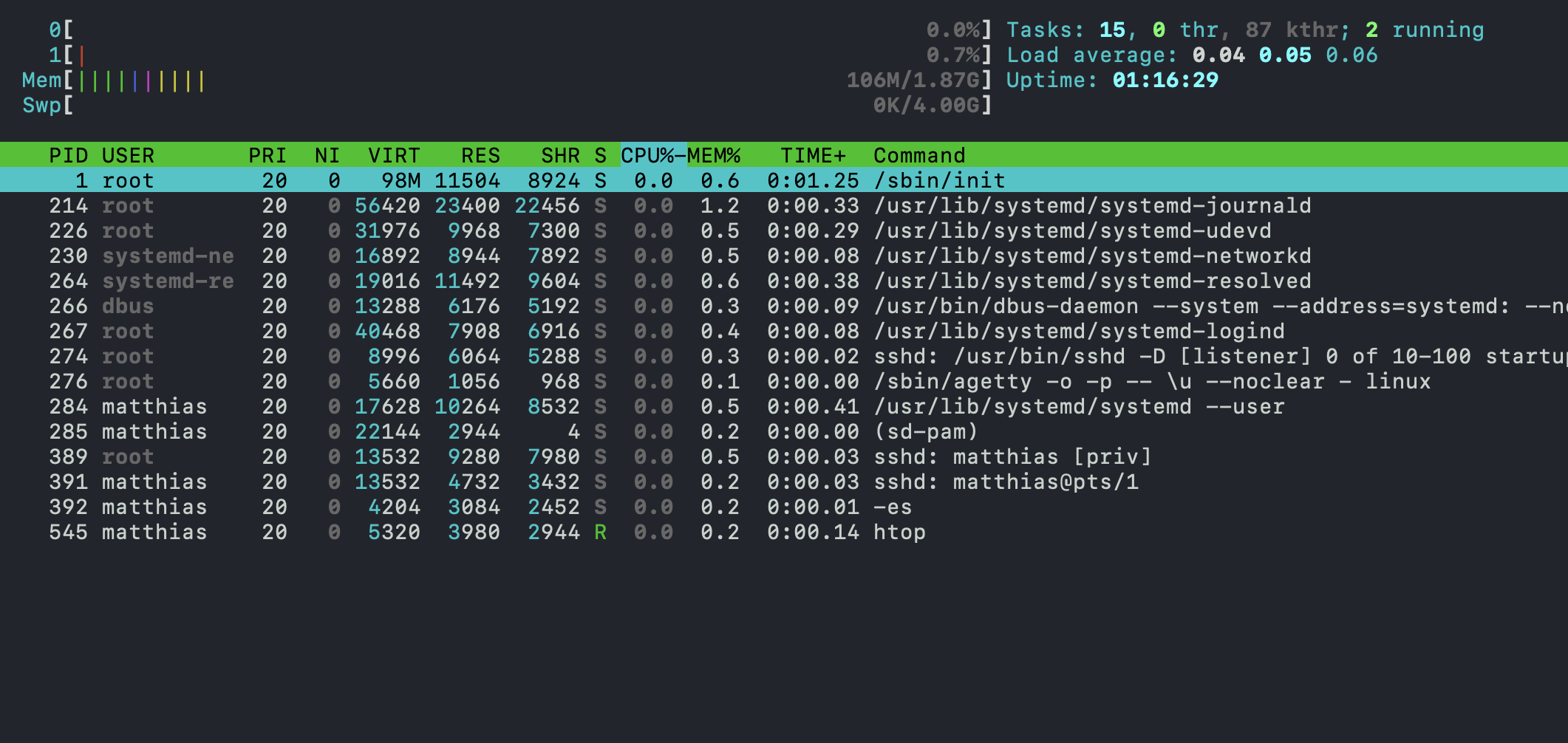
Also these 3 htop screenshots are from 3 different servers.
Also I don't understand what's going on, I don't think node.js is actually using that much memory.
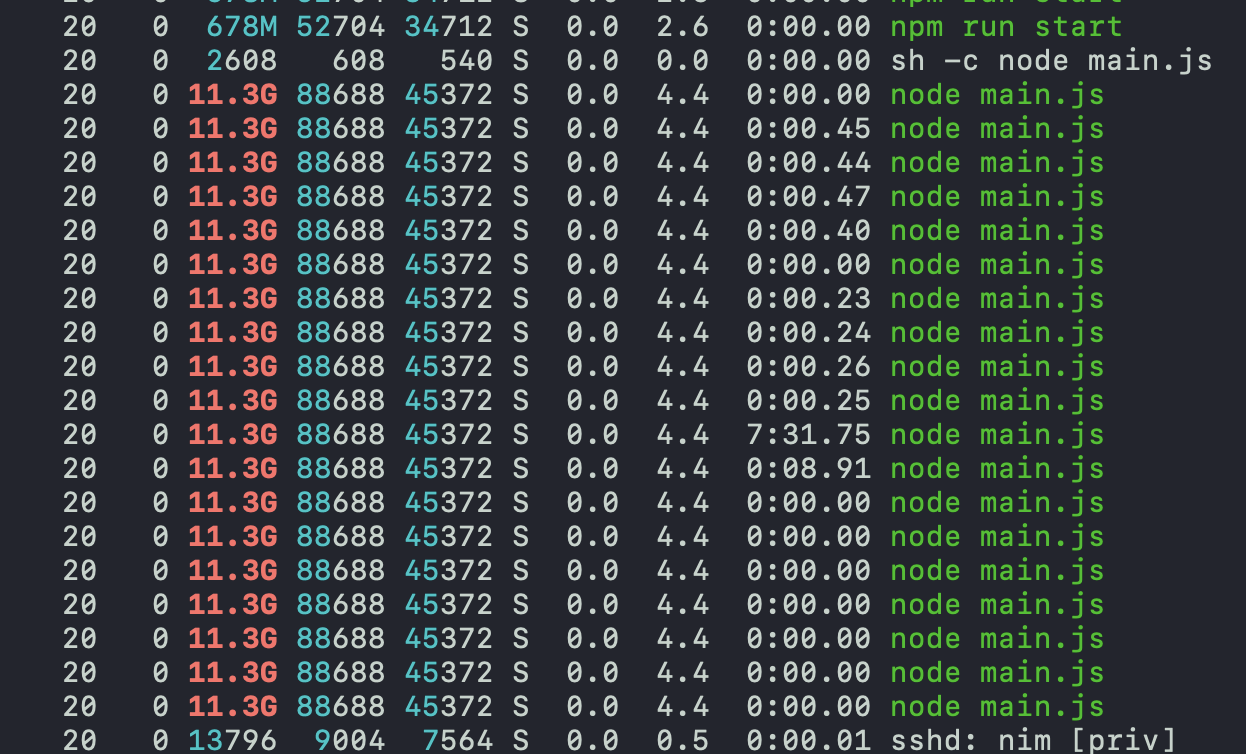
If it's possible to develop memory-conscious apps in node.js I don't know how.
Also, this is why I haven't released Astronomical Theater
yet, this honestly doesn't surprise me.

ES claims to not have aliases, but will do a lookup for variables of the form "fn-CMD" when CMD is run, and replace them if they exist.
So aliases look like:
```
fn-l = "ls"
```
I think they did this so that functions could be syntax sugar for as follows:
```
fn l {
ls $*
}
# Is the same as
fn-l @ {
ls $*
}
```
Where `@ { … }` is already the syntax for a lambda.
Still seems pretty bad.
So I theorized about this block-based language. And ES has "program fragments" that are basically just my blocks.
=> https://thoughts.learnerpages.com/?show=55b51146-2a55-471b-8957-6ac3dc929427
```
{ echo "hello"; echo "world"; } # prints "hello\nworld"
x = { echo hello, world }
$x # prints "hello, world"
myfunc $x # Calls myfunc with the block x as a parameter
```
Since ES is a shell, it can get away with doing what I didn't want to do, which is conditionally expand and evaluate the block based on position, since you have to use `$` to reference variables in ES anyways.
(ES is based on rc, it's possible rc does the same thing, I don't know.)
I picked up a computer from like 2006, but it's 64 bit, so I can just put modern Arch on it. Which I think is kind of beautiful, and it
makes me a bit sad that things are moving towards Arm. We're in the x86-64 golden age of computers.
Something about Bethesda moving to Steam even though Steam takes a 30% cut. Maybe Apple isn't evil.
I think, that part of the reason that programming languages don't support out-of-the-box exact arithmetic is that it's possible to construct
arbitrarily "complex" numbers.
something something Gödel's Incompleteness Theorem, "There is no recursively related notation-system which gives a name to every constructive ordinal" -Church and Kleene (from GEB)
Tell me this isn't dumb, I fricking dare you. Defend this behavior, you won't.
```julia
julia> parse(BigFloat, "0.1") + parse(BigFloat, "0.2")
0.3000000000000000000000000000000000000000000000000000000000000000000000000000017
```
All I want out of a programming language is being able to add `0.1` and `0.2` and get `0.3`. Is that too much to ask?
Why does fricking Julia use IEEE floats?
All I want is arbitrary precision numbers and it feels like `bc` is the only language that supports them.
The use of "wimdy" to mean a 'an unlikely outcome' is possibly my favorite example of the evolution of language.
'Through Jesus, everyone who believes is freed from everything from which you could not be freed by the law of Moses'
-Acts 13:39, paraphrased
The other day I was thinking, 'why did I delete the KA organ harvesting roleplay discord server.' And I just found some chat logs.
Let's just say that I no longer regret deleting it.
(Note to self: the transcript is in my DMs with Robert)
This website is actually just an IP-gathering honeypot. If you're not using a VPN right now, I've saved your IP into the Apache log files!
Option number 1: Submit homework assignment I've already done.
Option number 2: Eat dinner
Option number 3: Play Minecraft
Wanna guess which one I'm going to do?
I'm unimpressed with alt-j's new album. It feels like it's trying too hard to be deep and emotional. And what I historically liked about
Alt-J was how light their songs were.
Running 100m in 30º weather might not be the best way to stave off an anxiety attack, but it works. My heart is now angry at me for
different reasons.
There's something else, some other problem that I have. Not just the desire for perfection, but some sort of anxiety. I'm so stressed.
It's like my mind and my heart expect or need to be in a fight or flight situation and so when I'm a bit nervous about a group project they're like, 'this is it!' and my heart rate is 103.
I think I need to exercise more.
AoT hasn't dropped off yet so I'm basically just waiting for it to end so I can start my anime arc.
Michael M (@MikeMcl on Github, default profile picture, no bio), maintains decimal.js, which has 1.7 million users. XKCD 2347 moment.
AAAQAHHAHAHHAHAHHAHHAHAHAHAHAHHAHAHHAHDAWUDHAUOWDHAW DNAWI DANW DAW DAN WDAB WIODNBAIW ONDAOIWN DAIPWND AW DAOIcant'it sall in my head
ajlwdba jlwndk;waln ldjan o;awipnb djnawip odnaipw dnao[wjnd aopinwdalksndklnalknsdklansdklnmklmklmkllkmlkmlkmkmaas alsdmsad mklamwdklm saklmmsakldmlk malkmsdlk malksmd klasmdlk msaklm klmadlkma alksmd lkasmd l/kasmndfl jajlnajklnefbjkaeln kf;anf lkanef ipoj[
I would bet money that Astronomical Theater (my Gemini reverse-proxy/server) has a directory traversal bug.
Every time I think I know Javascript it throws me a curveball.
I expected `[undefined].toString()` to return `"[undefined]"` but it instead returns `[]`.
`(undefined).toString()` is an error but `undefined + ""` is `"undefined"`.
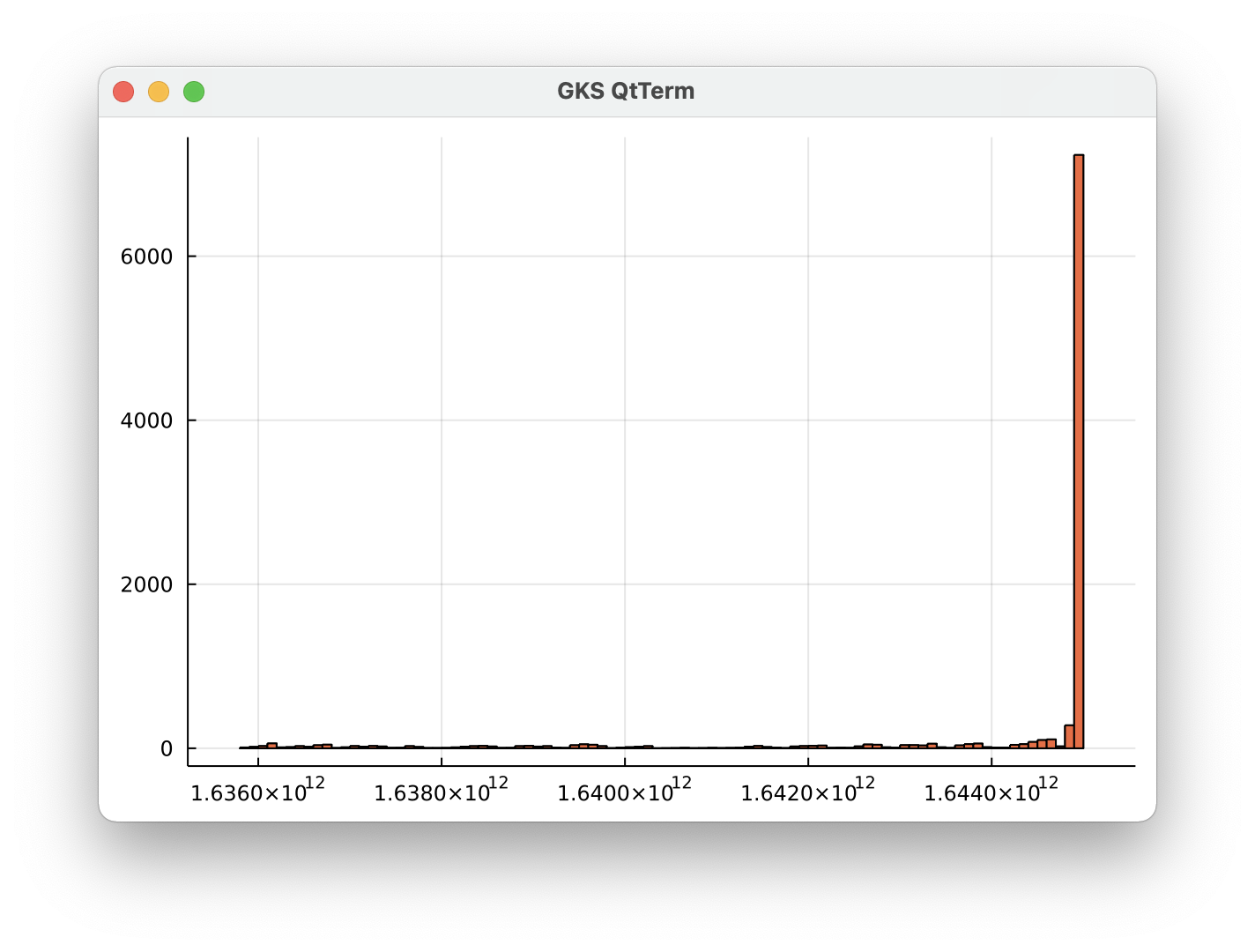
I think this is what they call a data crime
I'll give you a hint, the x-axis is unix timestamps
This is my attempt at blackout poetry. It gave me slightly more appreciation for the medium, but I still think blackout poetry is dumb.
The source is some random book. I used exactly one page. I tried to persevere layout when transcribing for this site, but it’s obviously imperfect. “Mutilated and deformed” is the name of the chapter in the book, and I left it in at the top of the page.
Edit: uh I forgot the link to the actual post. It’s the one from a few days ago
Thinking about *Check, please* again.
Honestly I probably just need to read more fiction, my standards are so low.
But like, so many things don’t meet my standards. Like none of the *Check, Please* characters are great. They’re good, but the story and worldbuilding is amazing. One of very very few non-fantasy stories to do 5-star worldbuilding.
It’s really impressive how much personality Bois gives the satellites in *17776*. He can’t use environment or appearance or actions, really,
to create personality. He has to do it all with dialogue. And he does it so well.
*insert Lunchables scene here.*
The legends over at Github looked at Markdown and went, 'nah, not complicated enough.'
=> https://github.blog/2022-02-14-include-diagrams-markdown-files-mermaid/
What is this.
This is why we need Gemtext.
Like, *Markdown* has feature creep.
There's actually a lot I could say here. This ties into *all* of the reasons Gemini is important. This is what I mean when I say you can't embed simplicity inside a complex system.
The colors on my external monitor so fricking washed out. It makes Vivaldi look awful. And I can't fix the color settings because something
magically reverts them every time I do.
CoFH "Don't Be a Jerk" License v2 has shot up my list of favorite licenses.
It's basically all rights reserved, but you're allowed to fork, modify, or use it (but not redistribute it). It allows derivate works, provided they are at least source-available. Basically, it's what people think they're getting when they blindly add an open source license to a project.
I had a bunch of thoughts earlier when I was in church and driving but I couldn't post them then and I don't feel like posting them now.
"Here needs no spies, nor eunuchs; her commit
Safe to thy foes, yea, to a marmoset."
- Elegy II "The Anagram" John Donne
Honestly, I'm speechless. Donne just murdered her right in front of me.
Donne really said, 'Why'd you let that mosquito stick its thing in you but you won't let me stick my thing in you' except the year is 1590
and it's like 400 years too early to be arguing that virginity is a social construct. There's ahead of your time and then there's 400 years ahead of your time. Legend and a half.
One of the things that makes the poem so enjoyable is that you can totally picture Donne's girlfriend smiling and rolling her eyes as Donne explains the grave injustice she has committed in killing the mosquito that he's using as a metaphor.
Sorry for Flea-posting again.
=> https://www.poetryfoundation.org/poems/46467/the-flea
There's totally a line in the Cloudflare WARP FAQ that implies that they're going to selectively give your IP to sites that pay them.
Cloudflare WARP is a free VPN. It seems reputable. It doesn't come up in the VPN conversation because Cloudflare doesn't advertise it as
such, they really don't want to complete with the "VPN" providers for some reason.
Edit: Oh so you know what it is. Is they're really focused on encrypting your connection to HTTP websites and running DNS over HTTP. And in some cases, like if a website is hosted on Cloudflare servers itself, then they don't bother e.g. hiding your IP address. So they can't advertise it as a true VPN. But it works for me. No more unencrypted DNS!
Every so often Vivaldi's performance gets worse and I feel like I have to toggle hardware acceleration to fix it.
The masculine urge to disconnect from contemporary society and join a Hutterite colony oh my word.
"IT IS STILL 100 SECONDS TO MIDNIGHT"
=> https://thebulletin.org/doomsday-clock/timeline/
Climate change is as concerning to people now as nuclear war was 70 years ago. The former is much less concerning to me than the latter.
"MUTILATED AND DEFORMED"
arguments on
justice critique the
system based on injustive violating
his own Similarly, to
parish is
violation
companies operate
"unjustly, capriciously, cruelly," people
support the bad and wasteful
Similarly
unjust
"tyrannic disposition" later
observes
love mortifies
inferiors
lord over that
human dignity vir-
tual ubiquity inefficient institution
workmen are "always just and equitable"
hours allow leisure
efficiency issues,
prompt masters to
rest living
stress
justice besides
cloath lodge
share produce themselves
Finally,
Absolutely quality HackerNews text posts today.
* A tor link to a black market site literally advertising a hit man for hire.
* ‘How do you cope with wasting all your potential?’ …I have an “IQ higher than 99.8% of people”…
* ‘How many calories am I burning sitting in my chair writing code?’
* “What’s the ultimate technology stack that top-tier hackers use?”
Absolute insanity. Who are these people?
Some quality runner ups as well but I can’t post everything.
I deleted Apollo from my phone and like 30 seconds later find myself searching for it because I can’t find it.
Ahhh
Apollo is a Reddit client btw
An ekphrastic
Corners pieced, stapled, sharp,
Threaded, pull taunt,
Edges, lines, angles
angled corners pieced
Threaded, pulled and tied
taunt string pulls corners
angled corners and lines
threaded, tied taunt
string slips through corners
angles and corners and lines
Me trying to explain to Reddit users why I'm not going to boycott Chick-fil-A because their CEO is homophobic. (Currently at -6 points.)
Hawtie and Hawtey are two different ranked bedwars players. (I'm pretty sure.)
Ranked Bedwars is like such a small community it seems like a wild coincidence.
I'm a big fan of continuous deployment. If you have code available, it should be the same code running in production.
I said this and then I fricking popped off.
=> https://thoughts.learnerpages.com/?show=8f027781-2a8c-4b71-a91a-7516764ecaeb
I'm on track for most posts ever this season.
This Thought might have been interesting, but my thought process getting there was pretty dumb.
=> https://thoughts.learnerpages.com/?show=e858a7d7-fc3c-41eb-a1a5-5dc4c4a5d4c2 Something about 'humans act like NPCs'
But the examples that prompted it were like, someone wearing the same jacket every day, or wearing a T-shirt for the club they were in. Like. I'm not wrong. But also. 'Humans walk places because that's the easiest way of getting there and they're lazy and therefore they are like NPCs.'
I think there's something there… But it's not nearly as interesting as I thought at the time.
Today on cursed code with Matthias:
```python
def test(value=[])
return value
a = test()
b = test()
a.append(1)
print(a) # [1]
print(b) # [1]
print(a is b) # True
```
Possibly my favorite Javascript feature is this:
```js
function foo() {
let x = 0;
return {
inc: function () {
x++;
};
get: function () {
return x;
}
};
}
const obj = foo();
obj.get(); // 0
obj.inc();
obj.get(); // 1
```
And this is obviously an ugly shim for OOP-style encapsulation that isn't needed. But this is just illustrative of the most common use for this feature.
And this feature isn't something that I normally use, or that is good practice to use. But if you couldn't do this in a language, it would just feel underpowered. (This does require functions to be passable by value, which similarly I think it very powerful.)
(You actually can do this in Python 3, with the `nonlocal` keyword, fun fact.)
This feels big.
I just released the source code for this site.
=> https://tildegit.org/matthias/WhisperMaPhone
It's not like totally un-ready. But it has lots of room for improvement.
The Vim learning curve is just so unbelievably steep.
I have a file without an extension. I want to tell Vim to syntax highlight it as markdown. In a GUI editor, that would be a button. But I've read the Vim help pages for `:colorscheme` `:language` `:syntax` and `:highlight` and none of them can be used to change the language Vim thinks the file is. (`:language` is for changing the interface language.)
Wordle would make a good subject for a meta-study of game theory and cheating.
Since Wordle is fundamentally about finding information, and yet, the information is right there in the source code if you're willing to peak behind the veil.
So you end up with a whole spectrum of amounts of information that you can convey, in between knowing nothing to knowing tomorrow's word. And it's really hard to define a strict line between cheating and not cheating.
Like, is using hints or guides in a puzzle game cheating?
I think this gives rise to the more fundamental question of 'what is platonicWordle?'. Since you inherently come into it with knowledge of English words, and yet, everyone has a different list of five-letter English words in their head. Someone who doesn't know English very well is playing the game at a different difficulty.
I think what I'm getting at is that cheating, and to a boarder extent, playing, puzzle games is a function of your mind. And no matter how tempting it is to turn the game into a black box of re-playability, that's just not the nature of the game.
I almost want to write a second About page. I like the length of the current one and don't want to keep updating it, but I also feel like
there are a number of important cultural elements that I didn't know or forgot to include.
This is impossibly such a garden. This is distributed as an informational message by The Library of Nomad. This is a sparrow, falling.
It's honestly profound the difference between "nothing can be perfect" and "everything can be better."
Obvious there's an attitude "half-full/half-empty" difference. But there's also logical difference. Saying that something isn't perfect doesn't imply that it can be better.
Edit:
Similarly, the second also implies a qualitative aspect that the first doesn't. It's not a binary, perfect or imperfect, it's about being better.
Focus on pursing excellence. Success and failure aren't ever in our full control. All we can control is what we choose to do right now, in this moment.
Focus on better outcomes. Any real situation can always be improved. (Don't worry about making it perfect, that's not possible.)
52% is better than 51%.
I wish I could write a poem to do justice to Matthew 10:29.
“Are not two sparrows sold for a penny? Yet not one of them will fall to the ground outside your Father’s care.”
NIV
“I choose marble and the Catholic Church because /
They say no, to natural beauty that lures us and kills us”
I almost cried looking at /r/Sh*ttyPoetry.
It’s not good poetry. But it’s there. And there’s so much of it. 10 poems being posted a day every day for 10 years. Most with 1 vote. Seen by no one. But that’s not why they were written. No one fishes for popularity on a subreddit with more posters than readers. No one hopes to kick-start a literature Nobel by opening /r/Sh*ttyPoetry. Just people with words filling their heads and overflowing. Just poems, crafted for the art of it, and shared because they could be, and maybe they could mean something to someone else. “But actually flowers”
"Kernel panic - not syncing: VFS: Unable to mount root fs on unknown-block(8,3)"
Yeah that's about what I expected from dd-ing to the hard drive.
Now the question is how to fix it. I didn't think this far ahead.
I'm going to start using all-caps more. It's an alternative to markup features, which is nice because it doesn't require markup.
Can't get over the fact that the Jazz Hands looked at a player named "Zee Phantom" and went, yep, ze/zir pronouns.
I guess I'm probably being too harsh, and I'm just not hearing about things like I used to. I found https://colors.withgoogle.com, which is
exactly the type of thing I'm talking about. A fun, marking gimmick. And it seems to have been created less than a week ago. But man I had to look for that.
Google used to publicize their R&D as a form of marketing.
You can't do that when you remove the Google branding from it.
You could view self-driving car R&D as a Marketing Expense. Instead it's listed as a loss in the "Other Bets" category of Alphabet's quarterly report.
I think the Alphabet creation/split really killed the culture at Google.
I have no evidence to back this up of course. But it seems like Google had this great culture of experimentation.
I'm just thinking back, Google did Google Maps in 2005 at a time when they were a *much* smaller company.
Now they have a much larger budget, and they're not doing the same types of things. I think part of that is that Alphabet exists and Google has been relegated to handling the day-to-day operation of existing products. Google's not supposed to branch out and do self driving cars or anything radically different. On the flip side, Alphabet is the *parent* company. They're bigger and so they have to be operated like an investing firm. They don't have a "culture of experimentation"—they're trying to diversify a portfolio.
I think Google would be in a lot better place today if they had created an R&D subsidiary instead of a holding company.
Everything exists to do one thing
And nothing does its thing well
The bluetooth won't connect
the left earbud is dead
the microwave beep
can wake the dead
The car won't start
The house will burn
We will all stumble
*Who, in the vast domain of humanity,*
*Has the power the will the reason to*
*Fight the broken dark scary imperfections*
There exists more than we can imagine today
But it will exist at the end of time
The world is full of problems but
The world is full of people
Me and Saihttam and God and generic male narrator #1 and [redacted] have lived in together in my head for years but suddenly I realize that
there's a female voice in here with me and I'm going insane. Sexist.
Wait let me try a word dump fump liump insanity brains and frycooks and sheep flying through the air at amillion miles an hour. Tuesday is
today and yesterdaya dn rails lines and fear and conjestion.
There's a voice in my head that isn't mine.
I'm calling her Mel.
I'm think I'm going insane this time.
I can't take it. I want to use simple software but it's like people think simple software means that it's bad or something.
Installed lwm. I can't figure out how to open an application. I don't want a fancy fuzzy-finder application list with professionally made icons. But I NEED TO BE ABLE TO OPEN AN APPLICATION. IT has to be POSSIBLE.
So I decided to try to ask for help in #linux on Libera.chat, right. Sounds reasonable. I don't have a window manager working, so I decide to install irssi, which is a very popular terminal-based IRC client.
It open with, I kid you not, 'if you're new, open our website to learn how to use irssi'
It is inexcusable in my mind to have to read online documentation to learn how to use software, period. I'm not learning a programming language. I'm trying to connect to an IRC server. I don't have a window manager installed.
So I open, in `links`, irssi.org (luckily irssi.org doesn't have any JS, so it works), select "Read Tutorials" > "Startup How-To" > "First Steps."
We're now a different program and 4 levels deep to try to learn how to connect to an IRC server. IRSSI doesn't *do anything* without walking through this. But it gets worse.
It explains that it's configured with some default servers, and gives the example that we can use `/CONNECT liberachat` and `/JOIN #irssi` to join. That sounds great. That's all I want. I close `links`, open issri again. Enter `/CONNECT liberachat`. Doesn't work. Liberachat isn't found. It's not a preconfigured server.
And like. I'm using a terminal-based IRC client. I want minimalism. This isn't "Discord is good because it has stickers." I want pure-text communication. And I can't figure out how to use.
So I search for liberachat on my phone because I can't remember their domain name. And I open a second tab on my phone with the irssi docs because I now need to add a new server. I try it without the port, hoping that the port is standardized in 2022 but no. The examples given in the irssi docs don't specify ANYWHERE how to add a server including the port, for the record. So I try "irc.libera.chat:6697" and that doesn't work and then I try "/connect irc.libera.chat 6697" and that at least tries to connect but I get 'connection closed by remote peer' instantly.
I give up at this point. I use neovim as a my primary editor. I'm no stranger to terminal apps. But I can't guess how to use your software.
The biggest IRC server is Libera.chat.
Irssi is a very popular terminal IRC client.
The default port for servers in irssi is not the port
used by libera.chat.
It is virtually undocumented, and certainly unclear to me, how to add a server that doesn’t use the default port.
Cannot get over how based bill wurtz is.
“all 16 personalities belong to myers-briggs. depending on which way i answer the questions, i get to read a different one of their personalities”
They’re extending HTTP to add a whole new verb. Absolute nightmare.
I understand the use case. Working with graphQL is currently painful. I just kind of can’t believe that something so fundamental to the protocol is being extended at this point in time.
(Gemini is not extendable.)
This website plays with boundaries. But it does not try to break or surpass boundaries, because then they wouldn't be there to play with.
We just write so much poetry and so little of it is appreciated.
=> https://www.reddit.com/r/nonpoetry/comments/moge74/translation/
Transcript
"I believe there is
A divine revelation
Happening
Between us
I believe that
We are being
Shown
Each others words
Their power
Their intent
Their message
I believe
That there's a
Third party
Connecting us
A spirit of
Understanding
That moves between our
Throat
And each others
Ears
I believe that
You and I
Have the complete
And unwavering
Attention
And
Command
Of God
Or whoever
Allowing our tongues to
Wag with
Precision
And clarity
In order to
Shatter
The barriers
Formed by the
Limitations
Of language"
I've been thinking a lot about mutual respect recently.
I realized I don't respect random people on the internet but want them to respect me
A little bit of mutual respect goes a long way, and I think we have way too little online.
"I am addicted to nothing. That is, to being addicted to nothing."
I am addicted to being free.
I forgot how bad my website set up was. The absolute path to the certificate file for the Gemini version of Thoughts is hard-coded into the
source code for MatthiasPortzel.com
The thing I don't like about writing tests for code is that it's really hard to write good tests and too easy to give yourself a false
sense of confidence.
If there's an edge case you're forgetting about, you can write 10 tests covering basic cases
```
assert(sum(1) === 1)
assert(sum(1, 2) === 3)
assert(sum(1, 2, 3) === 6)
```
And that tells you nothing about the behavior if the last element is `NaN`.
And if you think, "oh I wonder if this works with `NaN`" you can try it or look at your code without importing a testing framework. The hard part about avoiding bugs is predicting the edge cases, not testing if it works in the edge cases.
I don't know, I don't get it.
The Blaseball fan's struggle is to remove the L from the second position of words it belongs in
GoodTimesWithScar is an inspiration. Absolutely incredible.
I don't even watch his videos regularly, but I have a large amount of respect for him.
We live in a purgatory where 97% of text is UTF-8 encoded but we can't write tools that assume arbitrary text is UTF-8.
The C preprocessor will replace `??<` with `{`, in case you don't have a `{` key.
Okay, the C standard requires it. It looks like GCC and Clang actually don't do trigraph replacement unless you request that they follow e.g. `-std=c17`
Reflexive build word dump brain freeze declogged and free and fly and me and life to the end of the full cup. Inside and outside, behind but
Not before. Meaningless and full despite. Free. Sky above. Me.
Daniel himself has updated my HN username so that’s pretty cool. Might start commenting there again.
Last short circuit the Moist Talkers beat us 18 times in a row *but* we won 2 consecutive games this short circuit, breaking the streak.
"Nobody beats the Jazzhands 20 times in a row"!
The cycles are coming again they're starting over the pain. It's hot in here.
I want to throw up. I want to
To quote myself, "Past like 10pm the solution to existential crises is simple; go to sleep, deal with it in the morning."
Hopefully I was wiser then than I am now.
Hacker News sorted by new is just some guy, linking his own Medium post linking to a Google Doc describing how Satoshi Nakamoto is Elon Musk
Cursed sorting algorithm that always returns a sorted list, but sometimes sorts increasing and sometimes decreasing.
I think the serverless people have some really interesting ideas. I definitely have a lot of respect for them.
Vivaldi crashed on me earlier. Spark crashed just now. This is pain.
All I want is perfect software.
"Unlike most IETF efforts, this document is not embarrassed to clearly state that we are simply stuffing more stuff in while we have the
editor open."
When I say it's hard being a perfectionist I mean that I had to unplug my external monitor because the color profile on it was off.
Someone suggested that the interview couldn't have gone any better if Fox paid them off. And like, I could almost believe it.
It has motive, which most conspiracy theories lack. Not just for Fox but for corporate America. That's the angle /r/AntiWork should be taking. Like you could sell that so hard. Ban that one person from the subreddit, and post an announcement about how they were bribed to throw the interview. It's like they haven't even read the instruction manual on how to start a communist revolution.
Oh yeah context I guess is important: https://www.reddit.com/r/OutOfTheLoop/comments/sd9ohb/whats_going_on_with_rantiwork_and_the_fox_news/
*The members of /r/AntiWork are surprised to learn that the subreddit is communist.*
So I've said before that Reddit is a left wing cult.
I retract that statement. My new theory is that the vast majority of Reddit users are moderate/centrist, but lack the critical thinking skills to realize that there are members pushing an incredibly left-wing agenda.
"I checked out the sub a few times, and I didn't realize that it was supposed to be anti-work (against work) [I thought it was just people talking about] bad bosses, bad companies to work for, and advice for people that are facing conflict" (+389)
You joined /r/AntiWork, and didn't realize it was about the abolition of work? They're not exactly subtlety about it. The description of the subreddit is "A subreddit for those who want to end work." The sidebar links to /r/Anarchy.
And they get publicity, they get a radical leftist on TV making communist talking points, and suddenly, the subreddit backtracks? Why?
This goes back to me taking everything literally. If you say you want to abolish work, I'm honestly surprised that you have a job at all. Next you're going to be telling me that Tumblr user @death2america doesn't want to abolish the United States.
The key to understanding the Trolley Problem is that there's implicitly an antagonist who is responsible for constructing the hypothetical.
If this is what that looks like, then I’m not interested.
Remind me to decline if I’m ever offered a Nobel prize.
I still can't get over the quarter that Apple made up over 100% of the mobile phone industry's revenue, because Samsung recalled all the
Note 7s and posted a huge loss for the quarter. So Apple made more money than every phone company (including Apple), combined.
Writing code for me is like a jigsaw puzzle. If I see two pieces that connect, I'm going to grab them off the table and put them together,
even if I don't have anything else that they connect to. So it's really weird to do code analysis on my programs before I'm done writing them, because they're not complete, and they're not even internally consistent.
(I don't want to sound like I'm the only one that thinks this. There's some really interesting work being done to try to design editors and type checkers around "holes." But it's all experimental for now.)
I'm like almost ADHD when writing code. I'll start writing something, and be half way through a line, but my mind has been working on the
next line, so I jump down and write that line before I forget it, and then I go back and finish the line I was originally working on.
I think this is why I get so frustrated to with like anything that tries to analyze my code as I'm typing, either to give syntax errors, or even auto-indent it. Like your auto-indenter is going to be wrong if I took a break in the middle of writing my function, and I'm writing the line that calls the function. I don't mind it if I can fix the indention obviously, but like some editors *force* indentation, and I have to go back and add closing brackets to the function declaration above.
*Ben Shapiro voice*
'Curious how your blog post about how Gemini is good, is shared over HTTPs.'
It's like these people have never read https://gemini.circumlunar.space. Which opens with 'Gemini will not replace the web.'
It's hard to teach tech because you want to start with simple, older technologies, because they're simpler, but they're also bad.
Like how do you teach someone about HTTPs and not HTTP? But you also have to make clear that websites in 2022 probably shouldn't be using HTTP.
How is this the first time I'm reading Steph Week's wiki page?
"Weeks is readily identified by his nine eyes and nine hands, each carrying a bat. The bats are named after the nine days of the week"
Jands really put all of the chaotic energy into one player. Munavoi is the chaotic scapegoat of the team.
The thing about Blaseball is that it's not a game, it's a cultural event. And as long as you know about it, you are participating.
Confused? So is everyone else. You can learn more about Blaseball, but it's structured such that you're pretty much always confused. The people that don't know what Blaseball is, provided they know *of* it, are just as much participants as anyone else.
'Just write simple HTML'
*Simple HTML is 100X more complicated than Gemtext!*
*Markdown is 10X more complicated than Gemtext*
Gemini gets so much hate for being different. I can't take it.
And like, since there's so little substance to Gemini, you really can't criticize it for anything but being different, but man, people do.
Like, there's no argument you can make against Gemini that you can't make against either a) Twitter having a character limit or b) any protocol that is not HTTP(s)+HTML.
I should totally start a crypto/Web3 arc. Ah! Matthias with an NFT profile picture, I can see it.
"I know I'd rather lose my life / than have to lose myself"
-Chemical Angel, Watsky
"But baby maybe it's a problem when you got a problem / and you get addicted to the cure"
-Tears To Diamonds, Watsky
Anti-anti-depressants is such a take.
Re-reading "On the Arbitration of Self" which I haven't read since I wrote it, and like, wow. Rhetorically I'm off the wall.
"Though intuition cries out in protest, logic ignores it."
If I forgot that I wrote that, and you showed it to me, I wouldn't believe you that I wrote it. It does not match any writing style that I've used for anything else as far as I can remember.
=> https://rigby.krikorian.ca/post/8410098d-b13e-44e2-a244-b59fdaf080cc
(Let me know if this link breaks, I have a backup.)
"Are we back?"
The start of The Incomparable 2021 Clip Show is so good. They just open with the clip loop. Off the bat.
It's interesting, since I've added a search page here, I've started to use this more as a personal knowledge repository. Which was really
not how it was built, but like, if it functions like "for free," then why not?
I’m firmly in the lowercase “into” camp. I think they decided on the wrong way.
They decided on following the capitalization of official media, but no other Wikipedia page follows “official” portrayal over rules of grammar. See, e.g. the Wikipedia page of any band or company that stylized their own name in all lowercase.
But like, I’m sure there’s a reason that they decided the way they did and I haven’t read the 40,000 word argument or the Wikipedia style guide or anything.
For some reason it’s easier for me to compliment people in Toki Pona. Normally I’m not very good at complimenting people.
Which is kind of ironic, since TP is supposed to be “polite by default.” Like, I don’t need to end all my sentences with “sina pona” but I want to.
sina mute li pona.
My generation has an interesting relationship with poetry.
This post brought to you by /r/nonpoetry
You can’t tell me e e cummings wouldn’t use neopronouns. Like the type of person who always wrote his name in lower case would totally be on
board with more interesting pronouns. (Unfortunately, I’m not about to guess what pronouns, that’s a slippery slope to retconning the gender of historical figures.)
People explaining UDP/TCP are like, 'TCP orders your packets, UDP doesn't. UDP stands for Unreliable. UDP is bad, TCP is good.'
*Always more nuance.*
Like if you get a 100% on a test, you're not just perfect, you've transcended the level of the material being tested.
I hate time I hate the concept of time I hate entropy I hate that everything falls apart if I don’t actively hold it together.
I'm playing chess but everyone else is playing checkers. But like, the game is actually checkers and I'm just overcomplicating it.
Even the Brandon Sanderson fans don’t like the *Rithmatist.*
It’s not that they don’t like it, but Sanderson just has written so much that there has to be something missed.
There have been days that have seen me better.
In other news, I crafted a master infusion crystal.
There's this guy on Youtube that posts railcart videos, and the comments are all "is this safe?" and like, your alternative is trainhopping
Down to 18 open tabs in Safari on my phone. I haven’t been at 0 tabs for as long as I can remember. I was at 150+ just a couple weeks ago,
I’ve been whittling them down.
Muted the Vivaldi Discord server. We had a good multi-year run, but I don’t check Discord enough anymore to stay on top of messages there.
Like, my brain has so many sources, so many pieces of media that I've consumed, that like, I could never come up with an original idea for
the rest of my life and just pass of things I've read on the internet as my own ideas. And like, I'm not Googling the question and copying an answer. I mean, I saw someone discussing this point on the internet 4 years ago and internalized their opinion and I honestly don't know if their opinion is mine or not because I haven't researched it myself but I somehow know enough to have a conversation about it. Like, I could pitch you 30 different video games, which are just blatantly stolen from Khan Academy, but I know that the original programs were unpopular or deleted and the games have taken on a new life in my head. If I wrote a cross-over fan fiction between two works that have probably each been read by ~1000 people, and I change the names of the characters, at some point does this become an original work? If every line of my poem comes from a different Reddit comment, is it my poetry?
There were a lot of scenes in *Polar Express* that pushed the boundaries of how I conceptualize human interactions.
Donne really said, 'why do girls never go for nice guys but let themselves be used by mosquitos.' In 1590.
I think one of the things that makes the flea so iconic to me is that it's like satire. Like it's not only funny, and the time period and
everything, but also, it implies the existence of a very different poem, which makes more legitimate arguments. And Donne didn't write that other poem. possibly the GOAT.
The problem with IQ is that it's one dimensional. (Aside from other obvious problems.) I think a 2-dimensional IQ test could be really
interesting.
I love browsing Hacker News by new. The front page tends to be the same topics, but New gets weird. Not least because of the "Ask HN" posts.
There are a lot of Ask HN posts made, most of which seem to take Hacker News as a divine bestower of knowledge. It's like Quora but a super specific demographic.
Ask HN exists to function like Ask Reddit. But it gets used like StackOverflow or worse, /r/Relationship_advice.
'Ask HN: How to deal with join pain?' 'How to stop people from stealing my SD cards' 'Should I buy my 4 year old color blind glasses' A whole bunch of questions that technically fit because they're tech, but should really be Google searches. 'Where to buy cables?' 'What YouTubers make JS tutorials?' Ah. The internet.
Can't believe they delayed the Blaseball broadcast. I'm so excited. I want Blaseball to be back.
Feature creep turns things that are boring into things that are bad.
For an example, let's say Mark is working as an engineer adding a smart assistant to a microwave. Mark has been effected by the disease of feature creep. (Whether Mark uses his own product, or is passionate about microwaves, or particularly cares about his job doesn't matter.)
When most people see a normal microwave ("base" microwave), they're bored by it. They've seen it before. When Mark sees a base microwave in his friend's house, because he's been effected by feature creep, he thinks "this microwave is bad because it doesn't have a voice assistant."
I'm being very particular with my wording. It's possible that Mark uses and loves his voice assistant microwave. But it's possible he doesn't. It's possible that he would be legitimately inconvenienced by the lack of a voice assistant. But the "feature creep" disease doesn't care about practicality. It effects the way Mark thinks about his friend's microwave, which Mark has never used.
It's not about liking features or missing them. You can be a smart-home enthusiast, of the opinion that all microwaves are best with voice assistants. But if you don't spend all your time around voice assistant microwaves, like Mark does, you can walk into your friend's house, and see a base microwave and not think anything of it.
Feature creep isn't about wanting more features. That's the other point. Mark doesn't want a camera or a TV or a laser projector in his microwave. Feature creep doesn't make you want more features.
Mark isn't dumb. Mark knows that not everyone has a smart microwave. He still calls a base microwave a "normal" microwave. It's not that the goalposts have moved. But a voice assistant microwave is not impressive to Mark anymore. And a base microwave is actively unimpressive.
Like, a golfer who starts passionately playing golf, practicing every day, and getting better, still knows that par is the standard, and knows that they're getting better. The first time they get better than par, they get a certain rush from it. The 100th time they get under par, they still know that they've a good job, but they don't feel the same way.
It's not an addiction either. Addictions cause you to suffer withdrawal or negative effects. Feature creep doesn't have negative mental effects, not really. It's just desensitizing you to existing features.
I think Gemini could have benefitted from more creativity in its medium. More than just a blog, while still being minimalistic of course.
Like this website, for example. Is pretty simple, but is also more interesting than a blog.
This recording is from like 4 months ago. Apparently my standards for readings were higher than or something, so I didn't post it.
I've had "nothing means, nothing only means" stuck in my head for days.
Source is https://www.reddit.com/r/seventhworldproblems/comments/pisi8g/runprotocolsoul_mate/hbsprqo/
Transcript
I was unprepared to see it. This scene, although chronologically in the middle and unimportant, serves to convey a defining tone that sets fire to the frame. To reveal what became, a man claiming to be the son of the atheist, master of the lost road west, to nowhere, nothing means nothing only means, a sketch of time, of a time of dust.
I waited by the last standing pillar. She's haunted me half my life. Nothing came. Some external words, or other, profane, but the text must be legible.
I might do why not? Might take a chrysalis form, a germ plasm, and then and again, one might hazard, reorganized, a bloody ghost when I arrive.
"ERROR: We've reached an unreachable state. Anything is possible. The limits were in our heads all along. Follow your dreams."
One of the things that I can do with this website that I can't do with most other mediums is pretend that my experiences are shared or
understood by everyone here, while acknowledging that they aren't universal. I'm not describing that well, but it makes sense, trust me.
I want friends but don’t want to talk to people. I just want to listen to them. It’s a struggle.
My real problem with editors is that I am unable to write code with any theme other than Atom One Dark.
Definitely a fun reading, will hopefully revisit it in the future. (From last night, edited to remove a break.)
Transcript
E. E. Cummings
Introduction to New Poems
The poems to come are for you and for me and are not for mostpeople– it’s no use trying to pretend that mostpeople and ourselves are alike. Mostpeople have less in common with ourselves than the squarerootofminusone. You and I are human beings;mostpeople are snobs. Take the matter of being born. What does being born mean to mostpeople? Catastrophe unmitigated. Socialrevolution. The cultured aristocrat yanked out of his hyperexclusively ultravoluptuous superpalazzo,and dumped into an incredibly vulgar detentioncamp swarming with every conceivable species of undesirable organism. Mostpeople fancy a guaranteed birthproof safetysuit of nondestructible selflessness. If mostpeople were to be born twice they’d improbably call it dying–
you and I are not snobs. We can never be born enough. We are human beings;for whom birth is a supremely welcome mystery,the mystery of growing:which happens only and whenever we are faithful to ourselves. You and I wear the dangerous looseness of doom and find it becoming. Life,for eternal us,is now’and now is much to busy being a little more than everything to seem anything,catastrophic included.
Life,for mostpeople,simply isn’t. Take the socalled standardofliving. What do mostpeople mean by “living”? They don’t mean living. They mean the latest and closest plural approximation to singular prenatal passivity which science,in its finite but unbounded wisdom,has succeeded in selling their wives. If science could fail,a mountain’s a mammal. Mostpeople’s wives could spot a genuine delusion of embryonic omnipotence immediately and will accept no substitutes.
-luckily for us,a mountain is a mammal. The plusorminus movie to end moving,the strictly scientific parlourgame of real unreality,the tyranny conceived in misconception and dedicated to the proposition that every man is a woman and any woman is a king,hasn’t a wheel to stand on. What their synthetic not to mention transparent majesty, mrsandmr collective foetus,would improbably call a ghost is walking. He isn’t a undream of anaesthetized impersons, or a cosmic comfortstation,or a transcedentally sterilized lookiesoundiefeelietastiesmellie. He is a healthily complex,a naturally homogenous,citizen of immorality. The now of his each pitying free imperfect gesture,his any birth of breathing,insults perfected inframortally milleniums of slavishness. He is a little more than everything,he is democracy;he is alive:he is ourselves.
Miracles are to come. With you I leave a remembrance of miracles: they are somebody who can love and who shall be continually reborn,a human being;somebody who said to those near him,when his fingers would not hold a brush “tie it to my hand”–
nothing proving or sick or partial. Nothing false,nothing difficult or easy or small or colossal. Nothing ordinary or extraordinary,nothing emptied or filled,real or unreal;nothing feeble and known or clumsy and guessed. Everywhere tints childrening,innocent spontaneaous,true. Nowhere possibly what flesh and impossibly such a garden,but actually flowers which breasts are amoung the very mouths of light. Nothing believed or doubted;brain over heart, surface:nowhere hating or to fear;shadow,mind without soul. Only how measureless cool flames of making;only each other building always distinct selves of mutual entirely opening;only alive. Never the murdered finalities of wherewhen and yesno,impotent nongames of wrongright and rightwrong;never to gain or pause,never the soft adventure of undoom,greedy anguishes and cringing ecstasies of inexistence;never to rest and never to have;only to grow.
Always the beautiful answer who asks a more beautiful question
Always the beautiful answer who asks a more beautiful question
The SCP wiki has started fricking adding all sort of JS and cosmetic weirdness. The content! It's not about anything else!
Poetry attempts to capture
That emotion which surrounds us.
It tries to describe. It tries to portray.
The world and ourselves. The world.
Words in a loop like a lasso
attempt to capture leaves.
The words describe ourselves,
Evoke emotion unbounded
And feeling and meaning. Pain and joy alike
Poetry is words given power, words brought to life.
Winter 2021 Hytale update is all "we're far from done" & "we've been prototyping some fairly dramatic changes." I'm moving my release
estimate from late 2022 to 2024.
Oh my word I thought that was conservative. But somewhere else on their website they say "we no longer expect to be ready to launch Hytale before 2023 at the earliest, and it could very well take longer."
They were acquired by Riot in 2020, and the FAQ says
> Will this acquisition delay Hytale?
> We’re still aiming for Hytale to be playable by everyone in 2021.
I'm going to go out on a limb here and say that the acquisition has delayed Hytale. We'll be lucky to see it before 2025 at this point.
Can you imagine the person from Hypixel that had to explain to the Cloudflare engineers that their users have the server ping displayed on
the screen at all times and that if the latency increased by so much as 30ms, users will notice and complain. Network engineering nightmare.
I tried to do a reading of "Introduction to New Poems". The piece has so much energy and such a quick tempo, while also
being a total tongue twister. I was proud of it after finishing, I only really paused once, but listening to it again, I end up hesitating on every fifth syllable because cummings has invented a word. Might post it tomorrow if I remember.
Everything I've ever written is poetry.
I talk to myself a lot. And even if I'm not talking out loud, I have a constant narration in my head. And so almost everything I write is first said, and so is intended to be said.
My problem is that I am on anti-drugs. That is to say, I am doing not every drug. Which is kind of a lot. Possibly an uncountably infinite
number of drugs that I am not doing.
Countdown on the top of XKCD.com. What is it for?
=> https://www.explainxkcd.com/wiki/index.php/Countdown_in_header_text
I've editing some old posts to fix some super minor typos, but they're things that have been bothering me for a while, so it's pretty nice.
That's a lie. I do care. I care about everything. I want this website to be perfect. But I don't know where the 500 errors are and I don't
like Google and I have other things to do so I'm going to try to convince myself that I don't care, so that I can move on.
Google has emailed me to inform me that this site is returning 500 errors and will be downgraded in search results. I don't care.
.
Transcript
“A wave. A great and terrible wave of darkness will swallow us. Eternal night. An end to hope. Where do you hide from a shadow bigger than the world? Can we fight the night? Can we outrun darkness? The wave looks over all, growing as it consumes, engulfing everything.”
Now that I have editing on here, it's weird because I have to make a bunch of decisions about what gets edited and what doesn't.
Let's say, I can fix typos. Because that's why I added editing.
And I can edit content with a disclaimer (like "Edit:" or "Edited at [time] for [reason]").
And I can edit stylistically/formatting whenever I want. (Like if I invent a custom markup format I might need to go back and update links that are currently Gemini or markdown formatted).
I'll try to avoid editing content.
Kinda missing the expansion era NGL
Re-reading the Blaseball wiki page for the Turntables mod. "Any Win earned from a non-loss during the Regular Season will be converted to an Unwin." One of the most beautiful things I've ever read.
Apparently, WILLOW is Willow Smith, Will Smith's daughter, and made "Whip My Hair" back when she was 10. Doesn't change the fact that
"Transparent Soul" fricking slaps.
Tom Scott's "gamer-adjacent culture" Twitter thread lives in my head rent free.
Tom Scott on why he won't make a video on a video game:
> I'm not writing off video games. I was on a charity Among Us stream yesterday, it was fun. But I am writing off that gamer-adjacent culture, and trying to avoid the perception of even being _remotely_ connected to it.
After my last Thought, I immediately went to bed. So I guess my sleep schedule looks like this now.
Oh yeah I forgot to mention that I finished my re-read of Five Kingdoms on the 9th. It was very good. Definitely an epic story.
It also partially inspired a lot of the previous Thoughts, but that should go without saying.
So.
This is the end of an age.
I want my life to mean something. Not to other people, but to myself. I want to have meaning.
But I don't want a small meaning. I want an infinite meaning. I want the world in the palms of my hands.
Or at least to be a finger of the hands that hold the universe.
Every moment has meaning.
Would it really be worth it, to save a world if I couldn't remember it?
Would I go home?
"Do you fear being shaken by the shoulders like an etch-a-sketch. Being mugged for your memories? I do. They are my first most prized possession."
I want my memories to be valuable.
I want to see the stars.
"Do you feel it in your bones?"
Not 'what do I want'. I want everything. I want infinity. I want infinite perfect worlds with infinite perfect things and infinite perfect people.
But who do I want to be? Do I want to be a god? Do I want to be more?
Anything I create will be less than me. And I am imperfect.
I want to be perfect.
I want to spectate. I want to fly.
I want to be Matthias. I want to be weird to be memorable. I want people to remember me. But who do I want to be.
I want to know. I want to know what I am doing. I want to have confidence that I am right. Not to fly, but to fight. For a cause. For the right cause.
I am nothing without other people.
"He just needed saving from himself."
I want to be powerful.
I had a fricking bracket in the directory name so of course it didn't build.
This is the first and last time I use special characters in my
filenames.
Fairly big update today. Everything looks exactly the same, except for the few things that don't.
“A wave. A great and terrible wave of darkness will swallow us. Eternal night. An end to hope. Where do you hide from a shadow bigger than
the world? Can we fight the night? Can we outrun darkness? The wave looks over all, growing as it consumes, engulfing everything.”
My concern with the metaverse is not that it's impossible to make, but that you would end up making something like EVE Online.
I finished my re-read of the fourth Five Kingdoms. (I think this was my 3rd time through it, I reread it right after I read it the first
time.) It looks like I won’t be able to read the 5th book before tomorrow, unfortunately.
“You could see your surroundings best during the day, but when could you see the farthest? At night. The stars.”
One of my personal mottos is “always more nuance.” Truth is fractal, and the more detail you can provide, the closer you get to the truth.
I was born at the wrong time, but like, by a couple of years. If I had been born 5 years earlier I would be such a chad.
I’m stating the obvious but Toki Pona has a tiny vocabulary. If I want to say “good morning” the closest I can get is “tenpo pona”
Just learned about vim easy mode (`-y`). All the people are Hacker News are just being mean, but I'm about to fricking us it as my default
editor. After I configure some iTerm key re-mappings so I can use command instead of control.
After the Dragonwatch 2 twist I protested Mull for a couple of days, but I can’t last long. I have an addiction, you see. I just got to the
Hunter reveal in the third Five Kingdoms. It happens way later in the book than I expected (still not at the very end like in Dragonwatch, though *glare*.)
This is “camels, microscopes, yams, hydrogen, coral reefs, mannequins, poems, comets, mousetraps, sarcasm, cacti, labyrinths”
“Contains less than 2% uranium, cyanide, cobwebs, magma, polio.”
"I would fight a duel for a trifle, for an insult, for a blow;"
> understand me, I would fight a duel for a trifle, for an insult, for a blow; and the more so that, thanks to my skill in all bodily exercises, and the indifference to danger I have gradually acquired, I should be almost certain to kill my man. Oh, I would fight for such a cause; but in return for a slow, profound, eternal torture, I would give back the same, were it possible; an eye for an eye, a tooth for a tooth, as the Orientalists say,—our masters in everything,—those favored creatures who have formed for themselves a life of dreams and a paradise of realities.
-The Count of Monte Cristo
Okay this is authorization attempt number 3.
I got rid of the code referenced in my second ever Thought.
=> https://thoughts.learnerpages.com/?show=d90ad16e-df3a-437f-b4fc-be2c9539b9d2
I shouldn't have technical debt on this website; it's like 500 lines of Python. And yet, when I rewrite the 10 lines that control
authentication, suddenly I can't render UTF-8 characters. \*sigh*
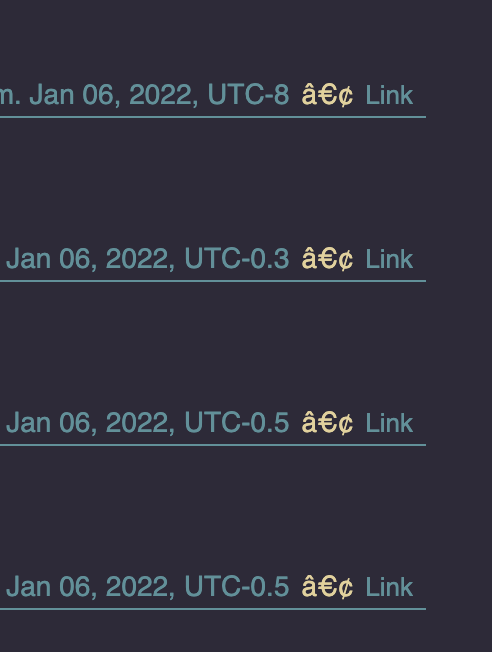
*And we're back!*
Bit of downtime there, I got frustrated. I tried to move the login page to HTTP Basic auth, and it worked locally, but on the server didn't authenticate me, without any error messages. So I took the website down for a bit out of frustration. I've reverted to a working state.
```
Why the fricking hell is logging with Apache so fricking bad! So me the fricking error log!? What the frick? 18:33
Sorry for the downtime. I'm not smart enough to make a website I guess. Sorry. 18:33
AAADAHWDUAHDAHAHAHAHAHAHHHHHHHAHAHHHHHHHH 21:18
If you have an endpoint that returns 401 Unauthorized and a Basic Auth prompt, Firefox doesn't log it in the network console. 21:24
"You need a plot. What you wanna witness with this life you got?" 11:14
```
I really wish Lite or Lite XL was good. The problem is that they start by building the UI/rendering from scratch, and it's just not polished
I want NOTHING highlighted, VS Code. Unless I select it by dragging my mouse, there should not be any highlighting happening.
I click on a word and VS Code is like 'Oh! Let's make that word a different color! And we can highlight every other instance of that word! And let's highlight the enclosing brackets! And make the indent-guide for the current indentation level a different color! And draw a box around the current line!'
Me: "Please move the cursor and then stop!"
Screw it I'm installing VS code. It's getting uninstalled the first time it crashes or freezes though.
Atom is being so laggy as to be unusable. I'm looking at close to a second of input delay after my keystrokes.
I'm seriously about to switch back to fricking Xi because all I want is syntax highlighting and the ability to type and have my letters show up.
Okay so I almost have the post page working without Javascript. But I need to ask the user for the timezone. Hm.
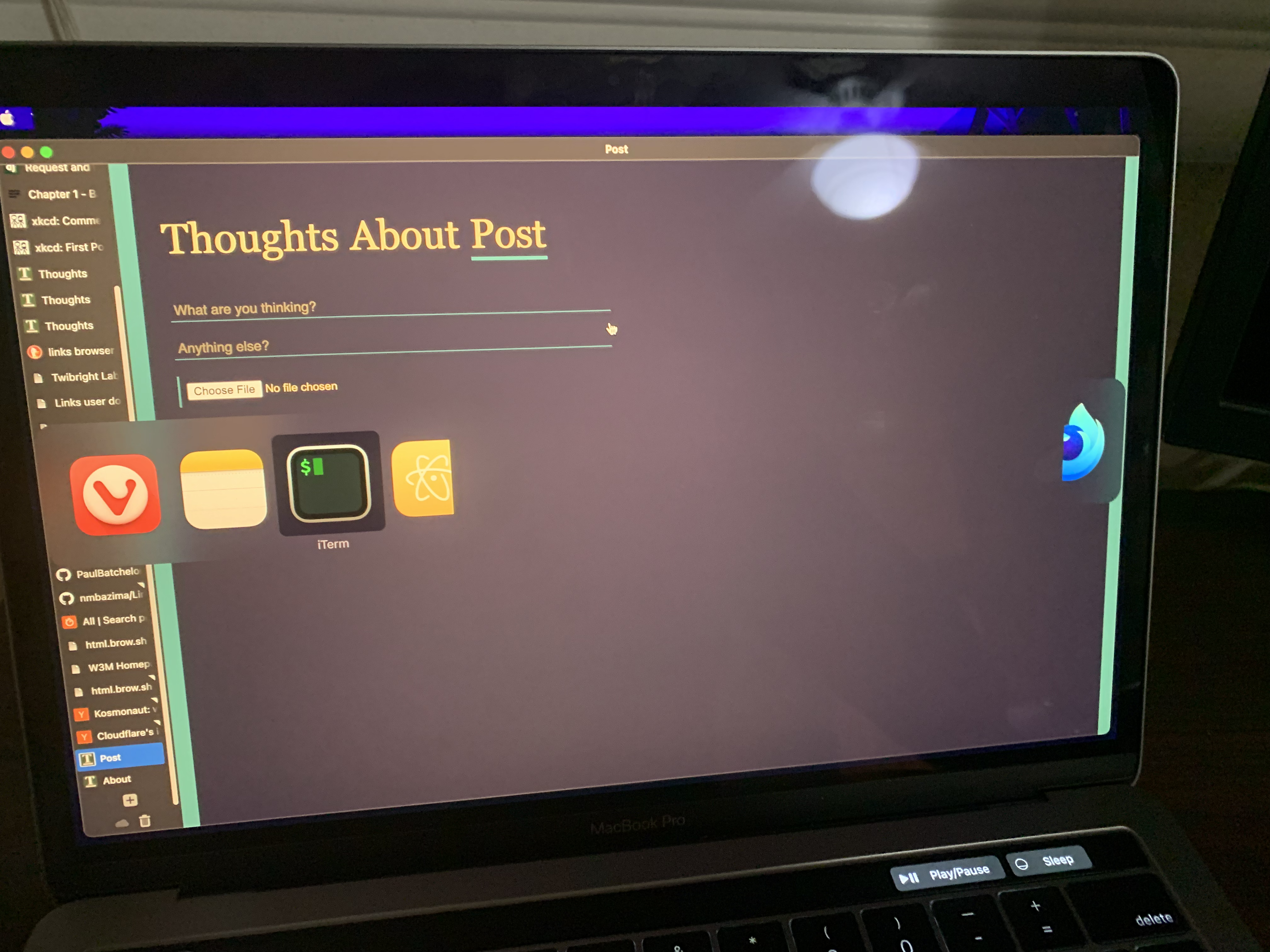
WiFi really is an underappreciated invention. I'm outside on my computer!
(At least Linux users don't take WiFi for granted.)
I think about the Pit of Success a lot.
=> https://blog.codinghorror.com/falling-into-the-pit-of-success/
The idea behind the pit of success is there's some metaphorical "gravity" pulling you down, analogous to doing whatever is easiest, and in some programming languages that pulls you down into traps, and in other languages that pulls you into the best possible scenario.
The Pit of success wasn't meant to be graphed. But I like to graph things, so let's make some tweaks.
```Graph of Quality vs. Effort, showing a hill-shape
Q
u
a / - \
l / \
i / \
t __/
y
Effort
```
Suddenly, instead of a pit of success, we have a hill of success. This way of graphing things makes sense Quality is the dependent variable. "Gravity" is pulling us left, towards as little effort as a possible.
What makes the pit of success really interesting is that you end up in a place where spending more time leads to a worse product. And this way of graphing make this really obvious. Increasing effort, past a certain point, gives an actually worse product.
This might be hard to believe, but it's because we're really good at recognizing when there's not sufficient payoff and not continuing to work in that way. The basic example is re-implementing some library yourself. It takes more time and you likely end up with a worse result, when compared to using a pre-existing library.
The further point to make is that most languages and programming environments don't look like this. They don't have a pit of success. Instead, what you often see is *diminishing results* for increasing Effort. So instead of this nice peak, that gives you a nice stopping point, you end up with a flat area. And this where a lot of projects die. When you get to the point where it doesn't make sense to continue putting in effort.
But! There's an even worse scenario! In the case that an environment is very developer hostile, it looks like a logarithmic graph. There are no local maximums, no nice stopping points. It's always possible to make your product better, but more and more effort is required to do so. This is why creating Minecraft maps is hell.
I haven't written a computer program in months. My brain has rotted. I have forgotten how to write code.
I still think about code, of course. I'll never stop thinking about it. But writing it? Oooh, I don't know.
Oh yeah just so it's clear, every time I say "I'm on drugs" I'm joking. I've never done a drug in my life.
I am on so many drugs, and so to reflect that, I'm updating the color scheme again, to back to the prototype color scheme.
Uh, here's my reading of the about page.
I'm sure it's garbage and there's a reason I didn't publish it earlier, but I want to do something, you know.
Transcript
Just me reading the text from https://thoughts.learnerpages.com/about
I am so screwed up.
Screw it, I'm giving the second *Dragonwatch* 3 stars out of spite. Please. My characters.
“Do you fear being shaken by the shoulders like an Etch A Sketch? Being mugged for your memories? I do. They are my first most prized
possession”
All I'm saying, is that at the end of the fifth *Fablehaven*, when Venessa says, "The only way to be safe from the Sphinx is if he ceases to
exist" maybe someone should have paid attention…aside from making a comment about her appearance. Might have been a good idea…
Just skimmed a re-read of the first *Dragonwatch*, then finished the second. What the fricking hell?
I was under the impression, for some reason, that *Dragonwatch* targeted the same, younger, demographic that *Fablehaven* does. (Maybe because Mull has said as much multiple times. Honestly, that's part of the reason that I didn't read *Dragonwatch* earlier.)
But I'm getting ahead of myself. The first book is pretty bad. I gave it like 4 stars when I first read it, but 4 stars for Mull is embarrassing. That's like, he's in exactly the genre that I want to read, but he's writing too poorly to get 5 stars. (Everything else by him that I had read was 5 stars.)
What the frick happens in *Beyonders* that this is less scary? I'm terrified of the end of this second *Dragonwatch*. This is a nightmere twist ending. This is like, 'Mull got bored and got Brandon Sanderson to ghost-write' levels of twist ending. Like, I never expect or enjoy brutal twists at the end of books. But I really don't expect it from Mull. Wow.
I guess there are some brutal betrayals and twists in *Fablehaven*, but those feel largely foreshadowed, don't effect the main cast of characters, are largely actionable (the characters can do something about them), and! they don't! happen at the very end of the book! This is honestly feels like Brandon Sanderson. What the hell.
I am *so glad* I didn't buy the second Dragonwatch at publication, because I would have been traumatized.
Still, traumatized is better than bored. Might just be because I've been re-reading, but I did appreciate the increase in action. I'm going to wait until morning to rate it because maybe this isn't actually a horror-story, and I'm just tired. but man!

You don't even know how tempted I am to subscribe to *Consumer Reports* magazine. I can't handle the internet.
I was like "how on earth can the Dewey Decimal System be homophobic?" but then
"topics relating to homosexuality were first added to the system under 132 (mental derangements)"
Oh.
"the spacious days of the stately three-volume novel seem very remote indeed…both opportunity and inclination are now lacking for such
extensive indulgence in the printed page."
Me who binge-read 5 *Fablehaven* books in the last 5 days. Uh.
I want to punch the person who wrote the Translator's Note for the abridged version of *The Count of Monte Cristo* so badly.
Background info, TLDR, there's a "standard abridged version" of The Count and it sucks.
=> https://abbreviatedmontecristo.blogspot.com/2021/08/section-one-supplement-how-to-identify.html
Transcript
"The prevailing taste for brevity has made the spacious days of the stately three-volume novel seem very remote indeed. A distinct prejudice against length now exists: a feeling that there is a necessary antithesis between quantity and quality. One of the results is that those delightfully interminable romances which beguiled the nights and days of our ancestors in so pleasant a fashion are now given no more than a passing nod of recognition. Unfortunate as this is, one has to admit it with as much philosophy as may be available for the purpose. Life then had broader margins, and both opportunity and inclination are now lacking for such extensive indulgence in the printed page.
This, then, is felt to be sufficient apology for the present abridgement of one of the world’s masterpieces. It has been the object of the editor to provide the modern reader with a good translation and a moderately condensed version of Dumas’ narrative. This, while omitting, of necessity, some of the beauties of the original, has conserved the essentials of the story and condensed the incidents within what will be, from our point of view, more reasonable proportions. So the reader will miss no material part of that entertainment which the author, after his more leisurely fashion, intended him to enjoy."
The problem with design is that, by definition, you are creating an experience. And yet, it is impossible for you to control every aspect of
that experience.
The most obvious example in the digital age is screen size. Designing something for multiple screen sizes is next to impossible, and yet, has to be done. How can you do that? Design a piece of art with the knowledge that the user can come along and resize the window to literally any size they want, from 50-pixels wide to 5,000 pixels? You can't. So so often you see webpages or apps that only look good at a certain resolution, and you know, oh, that's how big the designer's screen was.
Is this what you wanted?
I'm bad at knowing what I want.
That's interesting.
Hmm. Is it true?
No one knows.
Some of the early color-schemes for this site were fricking wild.
Like, this was the original color scheme during my first dev sprint
```
--background-color: #2E2A39;
--text-color: #E3D096;
--accent-color: #53929B;
```
Django has built-in Pagination. Which I didn't know, but I'm glad I didn't use, since it's very different from what I have here.
Finished the fifth Fablehaven last night at 3am. It's pretty dang good.
Vanessa is one of the best characters from any piece of media. Icon.
Are not the shells of men, who disagree with their past selves and the rest of society, as beautiful as humans who are complete?
Okay pagination is fixed.
If you're not able to guess, all the issues arise from the fact that we'll be in "Winter 2021" until March, and there were still a couple of places where I was using the year of the last Thought, without adjusting for that 2-month offset.
Okay, let's do the 2021 music roundup.
(I'm not excited about it. Make anything a requirement and I run from it.)
(Then maybe I'll fix the front page so it doesn't show "Winter 2022.")
* AJR
* Sylvan Esso
* HONEYMOAN
* half•alive
* They Might Be Giants
* The Regrettes
* twenty one pilots
* Jars of Clay
* Saint Motel
* Imagine Dragons
No real surprises here. The first half of the list preforms well on plays/day, releasing hits like "Monday" that I listened to often. The last four artists contribute more of my hours of listen-time, but I rarely seek them out. AJR, of course, is an outlier by both metrics.
The thing about the shortcuts app is that you can't actually use like a scripting language, because it's so fricking slow. It takes ~1
second to walk through the `for` loop, complete with graphical animation, for every one of my 1000 songs. So like it's not an alternative for cheap scripting in this use-case, or I imagine, any with more than ~100 items, at which point, why not do it by hand.
Some Technoblade fans are wishing Techno more subscribers. ('Here's to 11 million.') They don't understand. Unless I'm mistaken, if Techno
continues with Youtube, it will be either because of his love of it or for the money. Not for further subscribers. He'll give us the second elbow reveal, but I suspect he'll take a long break after that.
Okay I found it, it's glorious.
=> https://youtu.be/0xdWpkc9TyY?t=150
From 2017
> People laughed at me when I said it four years ago. We're going for ten million. Okay. That's always been the dream. People laughed at me four years ago. They'll probably laugh at me now. I'd laugh at me now. It's a pretty stupid goal to have right now. 'cause you know, I'm at 100 thousand.
> Not saying we'll hit it tomorrow, or this year, or the next three years, but possibly the fourth year, if I'm really lucky. The future is bright, who knows. We'll get there eventually.
We've made it. He's there.
'grats to Techno on 10 million. The man has legitimately aiming for this since he was like 15. He can do anything he sets his mind to.
I want to see if I can find the video where Techno hits 100,000 subscribers and says "only 1% of the way there." But I don't *really* feel like binging all of Techno's Skywars content tonight.
Homepage is broken. It's not handling the year change well. (Server's time zone is of course UTC, so it's 2022 already, even though I
have another 5 hours.) Ah.
Finished the third Fablehaven yesterday, and the fourth today. I might finish the fifth tonight, but probably not.
Power was out for a while, most of today.
It's nice to have this as a kind of journal. For now, I can mostly keep everything in here in my head—there are certain Thoughts that still
echo in my head incessantly, even after I've posted them. But eventually, in the future, I won't be able to remember, and then I'll have this record. I might shift tone slightly, being more factual, instead of cosplaying as an immaterial being like I normally do on here. It also lead to me adding an option to post privately, something that I've avoided, since the whole point of sharing is kind of lost if it's not public. But if this is for, not an audience, but myself in the future, then private Thoughts is a good idea.
Oh yeah I re-read the third Fablehaven. The series exists somewhere between quality and meaninglessness. Like a dry bread.
.
Transcript
"There must have been a moment at the beginning, where we could have said no. Somehow we missed it. Well, we’ll know better next time."
I haven't like really thought about a hard problem in a really long time.
I do tons of thinking, but it's pretty light thinking. Like the difference between re-reading a middle-grade fantasy novel and reading a non-fiction book on the brain. I do lots of the former, thousands and thousands of words a day. But I've been stuck on the same brain-books for a year.
Oh also I started reading *Pawn of Prophecy,* but I don't know if I'm going to be able to force myself through it. It's so fricking slow and
the main character is doing nothing and has no idea what's going on.
It's technically a re-read, I read it when I was probably in middle school, but remember nothing. Then again, that might be because there's nothing to remember.
(Business card with frustratingly little information) is such a great trope. Iconic.
Might take my phone number off of my business cards so it's just "Matthias Portzel • MatthiasPortzel.com"
Culture really is a wild thing. SCP-3999 is one of the primary inspirations for my About page. But to understand SCP-3999 I think it helps
to understand the other SCPs, including series 1, and the 4chan culture that produced them.
And like, that's only one of a dozen bits of culture and media that I reference in the About page.
I just want this website to be accessible from every device and it's failing in the experimental browser in my 2012 Kindle.
The good news is that I'm now less sick, so my brain has enough energy to blame me for all the world's problems. Still not enough energy to
fix them, but maybe we'll get there eventually.
Do other people not feel the need to fix all of the world's problems? I suppose not. I suppose they blame the problems on other people. Well
the buck has to stop somewhere. It might as well stop with me. It might as well all be my fault. It's probably not, but some of it is my fault. I can't fix all of it, but I can fix all of it, and I need to fix as much as I can. And I can't do that so I guess it's my fault.
It's like, when I created *The Imperfections* except I can't even bring myself to break down the problems. It's just, the first item on my
TODO list is: "Make every piece of software in the world perfect."
Sometimes HN is so good and so proud of citing primary sources, and other times @foone's summary of something someone said on Tumblr makes
it on the front page for some reason?
I wonder why I enjoy reading so much. I wonder if understanding that would help me understand other parts of who I am.
Mull really is a good writer. The Five Kingdoms books weren't perfect like I remembered them bing, but they were still easily 5 starts
compared to other books. Makes me want to Rereead Beyonders honestly. to see how good those were.
I finsihed the first two Five Kingdoms books. I realized I had 4/5 of them so I decided to re-read the series. I was orignally going ot skip
the third since I don't rememeber particularly likin it but I think the Hunter reveal happens in it and I'm kind of lookin gforward to that. The Hunter was mentioned a couple of times in the second biook, whihc I cdon't know if I picked up on my first time through. SDo now I have to decide if I'm finding a copy of the third book or skipping it or just giving up on re-reasing the series since tommorrow is christmax. Also I'm still sick so you don't get any spellchecking sorry.
I forgot how many times I've changed the colors of this site. Both the light and dark themes have gone through 2 major revisions and at
least a couple minor tweaks.
Vivaldi just crashed. Please I just want software that works.
There's no crash report.
At least my screen is fixed.
"I urge you, in view of God’s mercy: offer your body as a living sacrifice. This is your true and proper worship."
- Romans 12:1, paraphrased
I still know who I want to be but I don't know who I am.
Is there perfection? Is there imperfection? Is it minimalism?
Okay, one more Thought on *Fat Vampire*, Adam Rex, before I stop posting about it.
A lot of the times when I read a bad book, I start thinking about ways to improve it. But the premise of *Fat Vampire* is so problematic that there's just so little you can do with it. The premise is basically: "sucking blood from someone is sexual. Wouldn't it be screwed up if someone who doesn't have sex, like a 15-year-old nerd boy, got turned into a vampire?" And the problem is that you end up with this incel-like prompt where sex is basically required for this 15-year-old to live. (He can suck blood from animals, and does for a while, but it leaves him very weak, not able to live a normal life. Now you might be thinking, "is sucking the blood from animals not-sexual." And of course it is. He's unwilling to suck blood from a pig, but enjoys sucking blood from a deer a lot because a deer is sexy.) I can't do a logical breakdown of this book. Every person and thing that he sucks blood from throughout the book is problematic. There's no good way out.
Honestly, screw it, the one thing you needed to change was to make these adults. He would still be a jerk and the characters would all still be dumb, but like at least then it's an adult abusing his girlfriend. Instead of a 15-year-old abusing another 15-year-old.
I don't know what Rex was going for.
Okay okay. The inside flap calls it "satirical." Maybe it's a fine book and I'm just operating on a level far beneath it. I guess? Like, maybe the point is that the main-character is a jerk and you should use him as role model as how not to live your life. And it's a satire of incel-culture. In which case I'm having exactly the reaction I'm supposed to. But there's nothing in there that implies that the author disagrees with it. It's not overboard enough to imply to me that it's clearly all a joke. This is seriously the best I can do. The best way to fix this book is to make it worse so you can justify the satire label. Maybe it's a satire of *Twilight* and I haven't read *Twilight*.
Aging up the characters also would have helped my expectations a lot. It's described as Young Adult, but it has a *lot* more language and other adult themes than most stuff in that category.
I just read a couple of Goodread reviews. Most of them agree with me that it's bad, but one or two mention the "second level" that I missed. That is to say, the book tees up to be about a nerdy, awkward, boy gaining confidence and getting a girl. And it fails if you expect that. But there's another view that the main character is an unreliable narrator, and the story is actually about how he goes from being a weird jerk to be a bully. Which is certainly an interesting perspective. But I think Rex lays it on too thick, and it comes off as "nice boy is suddenly being mean to everyone for no reason."
Honestly, I don't think Rex knew what he wanted to do with it. I think it's like at half a layer of irony. He's kind of aware that what he's describing is weird, but he's not willing to commit to it being a weird book. So it all just comes off as awkward. It's like he thought that by writing a bad vampire book he could attract both people who liked vampire books and people who didn't.
Finished the book. I’m giving it 2/5 but I’m looking for reasons to give it less. Like, it’s not that bad. It’s 2/5 in all categories, but
there’s also nothing good. There are a few funny jokes. There are other books that I’ve given 2 stars to because they only get 2 stars on the things that I care about. But normally those books have something else going for them. I don’t enjoy tragedies, so when I’m rating books I don’t take into account how good of a tragedy it is. And *Fat Vampire* (Adam Rex) is a tragedy so it gets rated the same as other tragedies, but it’s bad. It’s a bad tragedy.
Also, somehow the ending is more homophobic than the rest of the book. Which is kind of impressive.
It is one of the worst books I’ve ever read. The first half is bad and funny, so at least I had things to say about it. But the second half is bad and not funny.
I don’t read books this bad unless there are unusual circumstances.
I don’t understand how Rex turns it around and writes one of the best books I’ve ever read 3 years later. I guess this is a romance and a tragedy strung along by jokes. And Cold Cereal is an adventure and a comedy. And Rex is a lot better at one of those things than the other.
I don’t think this book would have been published if it wasn’t in the middle of the Twilight movies coming out.
Sometimes you can write broken characters in such a way that their brokenness compliments each other.
Rex is not doing that in this book. He does in some of his other books, but in this book everyone is screwed up and they’re only hurting each other.
I can’t keep summarizing this book. I can’t take it.
There’s a whole paragraph in here about how he’s not homophobic he just thinks there are too many gay characters in comic books these days.
This is the main character, ostensibly a 15-year-old in 2010. Who used the f-slur to describe umbrellas earlier in the book.
To Rex’s credit, we made it half way through the book before there was a “lesbian porn” joke, so that’s better than some things. I just. I thought this was supposed to be about vampires why are the characters debating the quality of Neil Gaiman’s comics?
Maybe I’m just not a theater kid. Maybe I just don’t get it.
Sorry for spam-posting. I’m just trying to cope with this book. I’m not even half-way through. I might just go to bed.
Help, we are on page 4 of Rex describing the characters in the theater watching *The Rocky Horror Picture Show.*
If someone later in the book pulls out LSD, I think the score goes negative, wraps around, and becomes a 5-star book, for the meme.
Girl in the book just asked for help installing Linux. The year is 2010.
I’m howling. I’m now reading to see how bad this can get.
The insane thing is that Rex did characters well in Cold Cereal Saga. Two years later and he can write characters super well. But in 2010 he thinks normal flirting is asking for help with Linux. (This is not like an especially nerdy girl. The guy is established as a nerd. But the girl is described as a theater girl. Maybe 2010 was just a different time.)
There’s a lot more I could say I’m not getting into everything. I’m so bored of the book at this point, nothing has happened. But I don’t have my computer and I kind of want to finish it now so that I can rate it, because it’s on track for like 2 stars.
Okay the thing is I haven’t finished it and it’s quite possible that the story arc is actually about him coming out as gay, but like, is
that better? The main character’s attempts at flirting are so bad that the best case outcome is that he comes out as gay.
I feel like Rex would delete *Fat Vampire* if he could. I’m kind of glad you can’t delete books.
I’m sorry Rex but this is bad.
I still don’t understand where he’s going with it, but like, what?
Bare minimum context: I’m reading *Fat Vampire* by Adam Rex. The central conflict of the book is that the main character, a vampire, needs blood. But for unexplained reasons sucking the blood from someone is a sex act and the main character is very homophobic.
I honestly cannot tell if Rex spent a lot of time on Tumblr in 2008 or if he’s never used Tumblr.
Still can’t handle Adam Rex. My word.
He introduces 5 characters in 60 pages and all of them are insane.
I wish “I hear voices in my head that sound like radio commercials” had made it into the About page here. It’s a good quote.
I’m again amazed that someone else writes in that style.
That post is long, but the rest of their posts are short. Someone else creating a Thoughts page.
Although they may fall outside of a standard deviation of the mean.
> Freedom is a concept. Freedom from wanting to be free.
> Freedom to experience. Freedom to experience confinement.
> Freedom from the concept of freedom.
> The rain sings songs of longing as it hurls itself towards the hard rock asphalt. The heat from the road evaporates blissfully with each drop of moisture. Each drop of molecule, a world within itself, experiencing the bliss of being a drop of water, embracing the the heat of beingness.
Using `more` because `less` complains about my terminal.
My computer is in the shop so I'm using a web terminal on a computer that I can't install things on.
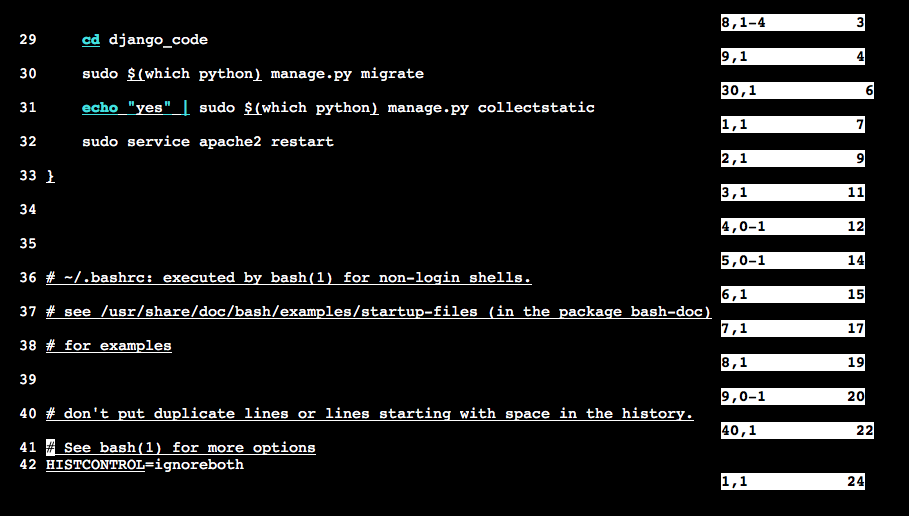
Just finished *Code Name Verity*, which I had previously read half of and given up on. It gets better in the second half, so it could
scrape 4 stars. Probably 3 though. Very good as far as books go, just not my style.
Thinking a lot about the Tumblr post, ‘we basically live in a gasoline-punk society, where nuclear energy has been available for decades’
I used to say that I think in code. But that's not accurate anymore. As I learned more about code I understand that code is an analogue for
my thought, and not the other way around.
What if instead of Reddit or similar, where you have a parent and then replies, you have something more like a forum, with a topic and posts
, but nested infinitely. So you see the headline on Reddit or HN, but clicking comments shows another list of headers ("Jokes", "Off topic", "Refutations", "Context", etc). (And then maybe you click a joke and it has sub-threads for "more jokes" or "anecdotes.") The obvious con being that most posts don't have enough to say about them for that to make sense. But it would theoretically help me navigate the conversation in the direction I want, and avoid some of the frustration that comes as a result of the comment section taking the conversation a completely different direction than I want.
Does a perfect Gemini site mirror its content to HTTP? does it respond to HTTP at all? Does it serve different content to Gemini and HTTP?
I just can't imagine myself being not insane. (How do I denote a screech? It's not "Aaaahhh" but like "Eeecheexxxe". Yeah that's how I feel)
One of the hand-waves that Gemini does is assuming that the other side of the pit of success doesn't exist.
I have no doubts that I would not have these problems if I was a different person, but I do not want to be a different person.
One of the interesting things about learning toki pona, since I don't know it yet, is that since it's vague, it's easy for me to justify
a translation making sense.
Last night I made an appointment at the Apple store to get my screen fixed because it has been showing these black bars of dead pixels.
And today I open my computer and it's working fine, no issues with the screen. No joke I have lived without a tenth of my screen for 3 months, and as soon as I make an appointment it fixes itself. It'll probably break again in a minute.
So roughly 1/2 the reason I want to learn toki pona is jan Misali, of course. And part of the reason is jan pona Alex.
But a part is jan Tepo, who is apparently active in the toki pona kulupu (community), but who I on follow on Twitter because of their work on iSH (an emulated Linux terminal device for iOS).
So Misali uploaded a toki pona lesson and since I'm subbed to them I guess that means I'm learning toki pona now.
My brain hurts so much and I've learned like "pona" and "sona." Here, let me try to say, "I'm learning toki pona": "mi sona toki pona." Woohoo! I'm so good.
Edit (Apr 10, 2022): That translation is wrong, it should be "mi sona e toki pona"
Did things use to be better? Did the web used to have fewer bugs? Am I just hypersensitive?
I'm typing this from Firefox. But like nothing fixes the fact that my screen is physically broken. I feel like I'm surrounded on all sides by pain and bugs.
Yeah, so if you don't have an adblocker Quizlet just loads ads infinitely, throttled by your internet or CPU. I'm at 100+ MB of ads.
I hate the web.
Quizlet is literally unusable without an adblocker. I don't get it. How is that good for business? Is it that hard to load a single ad?
Like I paid thousands of dollars for this computer and I would pay thousands more if it didn't have any bugs.
I would switch to Linux if it was better but it's just not.
I'm leaning more and more towards making my own OS.
I think not having the ability to support any "normal" software and expecting everything to be designed as an integrated part would actually be really interesting. That's what Apple software is supposed to be but in practicality that advantage is lost by the time you're using Vivaldi and and Atom and Python.
In particular, what leads to 95% of bugs in software is the exponential number of configurations. Every setting increases the number of possible combinations of settings exponentially. So if I didn't have any settings and only had to support one configuration—my configuration. I think I could eliminate a large number of bugs. Of course, it's next to impossible to get there, but that's a different point.
Screw it, I'm switching back to Safari as a default browser. I can't take this. I just want perfection.
I think it's impossible to do anything.
The Orion people are like, 'let's make a web browser that's exactly like Safari.' And it's like, so buggy. I'm not trying to diss them here. I think that's a great goal and I think that that should be achievable. But it's really not.
Like, what is this? Why is there a black bar here?

I feel for people that like listen to community feedback about their products.
It just looks painful. This guy's like 'I think this app should look like the Notes app did in OS X Lion.' Okay. No one else agrees with you, I'm sorry.
I miss the Blaseball wiki.
I wonder if there's something like wiki but with a better or different interface.
So one of the things that I want to add here is search. And it was originally supposed to happen before pagination. But search is
suprisingly difficult. I want to be indexed, right, for that sweet, sweet O(log n). And there like theoretically are libraries to do it for you. But I search for “GEB” and get posts about “Algebra.” And I have to figure out how to update the index when I make a new post and it’s kind of a mess.
I might just throw away the index and say O(2000) is fine. Because it would be. But the binary search!
I almost forgot about that time everyone used 🅱️ in their memes for like months until the mods of /r/dankmemes got sick of it and banned it
Instantly 🅱️illed the meme.
The more I think about it, the more I want to find a way to dump all of my old Tweets on to this website. Because while they were certainly
posted in a different context, most of them came out of the same mindset that led to this site (quick meaningless thoughts). And it would be nice to have them all in one place.
Even in the areas where I may not be an order of magnitude off of society's expectations, I'm an order of magnitude off of my own.
In high school, I would make myself get up and drive to school and be there by 7:15, even if my first class wasn't until the afternoon. And
people would ask me, "Matthias, why do you get here so early." And would reply to the effect of "because otherwise I would always be late." And I was right. Routine really was the only thing keeping me on the tracks.
This is a circle in which a robot spins.
This is the attack of the bees.
Oh yeah, I made a Rigby post earlier today with something I had
posted here.
I am on anti-drugs.
It turns out, if you go too long without consuming any drugs, your brain just pretends like it's on drugs anyways.
Creating software (or even hardware) that works is one thing. But to create anything that is "ergonomic, natural, intuitive, and user
friendly" is hard. Really hard. And like, that's the criteria. For whether your software actually gets used.
I have made lots of bad decisions. But! I have made some good decisions. I don't remember them, actually, but um, they should be there.
Commenters on Hacker News defending W3Schools. Look at this
=> https://www.w3schools.com/jsref/jsref_eval.asp
I quote:
> No NOT use eval()
> Executing JavaScript from a string is an BIG security risk.
> With eval(), malicious code can run inside your application without permission.
> With eval(), third-party code can see the scope of your application, whitch can lead to possible attacks.
Okay; so, I try to avoid mocking English-second-language speakers on here, it's one of my off-limits topics. And I don't know the context of the person who wrote that. But read that excerpt again out loud. Yeah.
And this is published content acting as an authority on the subject. I expect better from this page than from a random person or internet comment.
The MDN's page is a little long-winded, I'll admit. There are some phrases in the middle of the MDN's description that could be misleading. But there's so much more useful information in there. Performance, comparisons to `JSON.parse` and `new Function`, the behavior when `eval` is given a non-string object. Etc.
Like, I don't know how to respond to people on HN that are just wrong.
> [W3Schools is] criticized by the vocal newbies who are chasing the newest and shiniest.
Really? Then why is there an open letter from 2011 saying that "their faulty information is a detriment to the web"?
=> https://web.archive.org/web/20110412103745/http://w3fools.com/
Which has since been rescinded because W3School has improved on the addressed issues.
=> https://w3fools.com
(They went from not mentioning that eval could be harmful to "No NOT use eval()".)
I don't get it.
"We flip the switch, and it releases the bees. *Not the bees!* Yes the bees."
It is once again time for one of the best Youtube videos of all time.
=> https://youtu.be/ywWBy6J5gz8
People get so fricking ticked-off about Safari on iOS only kind-of allowing you to side load apps. And they compare it to IE. And it's like
you clearly have never designed a website for an IE version before 9.
Oh no! Safari's IndexDB implementation isn't spec-compliant (as of 2016). I have to use a library to store large amounts of data persistently on my user's devices. My website can't send phone users background notifications! What ever will I do‽
And Firefox gets a pass because they invented tabs 10 years ago.
This is why I love anecdotes about the past. You read documentation or people connected to the matter, and they're talking about random
stuff, feature support or some weird bug or something. But the anecdotes give you gold like:
> [Firefox] was quick, it was simple, it was much more standard-compliant, and absolutely none of that mattered.
> No, Firefox really got a foothold because it had tabs. IE 6 did not have tabs; if you wanted to open a second webpage, you opened another window…
> Firefox wasn’t the first tabbed browser, of course; the full Mozilla Suite’s browser had them, and the obscure (but scrappy!) Opera had had them for ages. But it was Firefox that took off, for various reasons, not least of which was that it didn’t have a giant [censored] ad bar at the top like Opera did.
In 2021, talking about why Firefox is losing marketshare, no one points out that the reason it gained market share in the first place was tabs. Like. That's very interesting to me.
=> https://eev.ee/blog/2020/02/01/old-css-new-css/
Every time. Every time I think I have a handle on how broken the web is, something comes up that's worse.
I still hold irrationally strong feelings about characters from Brandon Mull’s Five Kingdoms.
I’m almost angry at the AO3 authors paring Mira/Jace. You’re wrong and you do not understand the characters the way I do. Mira/Cole is still my OTP.
Finished *Without Bloodshed*.
He does a *lot* with the worldbuilding. I don't love Sci-fi, so I don't love it. I think he either should have toned it down a bit (e.g. cut a lot of the pure sci-fi: AIs, maglev's, etc. that don't effect plot), or else put it on a planet that's not Earth. Because half the worldbuilding is technological, but there's also a cultural element to the worldbuilding. And the culture of the people in the book really is not the same as Earth today. So it might have been helpful to separate that. Like, there was some big event, "Nationfall" that pushed their society to the way that it is. But Nationfall is never discussed, he's too busy discussing other elements of the worldbuilding. Yeah. There was an apocalyptic event that happened during the lifetime of some of the characters in the book and it's only ever alluded to. He's too busy talking about the history of the band or the symptoms of being a cat-person. Luckily for him, weird worldbuilding doesn't effect my enjoyment of the book.
I actually really like the pacing of the book. The characters are always under a little bit of tension, but still find to stop and chill. And that has a lot to do with writing style. The book takes place over a couple days, and most books with that timeframe are too fast-paced for me. But he does a good job of varying which character is under stress, for example. Or making short interludes time-wise, feel longer for the reader.
I'm neutral on the characters. Which is really the shame. He tried so hard, and I kind of see what he was going for. But like, 3/5 characters. All the characters except Morgan feel shallow. And he does a good job of developing Morgan over the course of the book, but it almost happens too quick for me to appreciate. I feel like we needed an extra bit at the start to introduce Morgan to me before Morgan starts to question everything.
Plot is fine. No complaints really. He tees a sequel pretty aggressively, which I don't love because I don't think I'll read a sequel. But he ties up enough for me to feel satisfied.
Oh, he does this interesting thing with a bunch of "string-pull" characters. They don't add anything. Doing string-pull characters is really hard because kind of by definition they aren't interacting directly with anything. And because of that it's hard for me to care about them, even when they're interacting with the story indirectly, or else interacting with each other. Like you could have cut all of the parts from the perspective of the devas and just told it from Morgan's perspective and I think it would have been fine. But that's the part that I think is just setting up the next books.
I think some of these points, where like I don't appreciate the characters or the world in the way that the author does, is a result of this being the second book written. But the website requests that I start here and not with *Starbreaker* so that's where I am.
Overall, 4/5. Weakest bit is the characters. Which again is a shame because I love the characters, but the book just doesn't use them very well. (Matthias's book rating scale reflects *only* my enjoyment of the book, not my evaluation of the book's quality.)
Oh my word. Not-resonant voice Tom Scott is something else. I can hear it. My word.
=> https://youtu.be/2QKPQ6JYVhU?t=265
My obsession with social media and internet communication is really just a result of loneliness.
It is my impression that this has profound implications in our understanding of machine learning.
Oh yeah I was reminded of that because Wesley is on the first page of Hacker News. This is what I mean by infinite connections.
Wesley never replied to my email.
I still check thoughts.page. They seem like they’re doing well.
Microsoft is in a weird position because they own a lot of random things that I tangentially interact with, but like, if they tried to get
any money from me I'd run in the other direction. I own Minecraft from before Microsoft bought it. I use Atom as one of my main editors. They own Electron, of course, which I can't escape from. And of course, Github. But I would stop using any of those if Microsoft tried to make a penny off of me.
It's fricking wild to me that Vim is the best editor in 2021. I mean, that's subjective obviously. But like, I use Vim. In 2021. And I don't
particularly like it.
But if you look at time to start, cross-platform availability, and syntax highlighting in a variety languages, Vim has Atom beat by a factor of 2 it feels like. And those are the only constraints I care about. Vim does lose major points for not supporting normal Mac keyboard shortcuts. Maybe I'll make a list of Matthias' Requirements for the Perfect Text Editor.
Why isn’t this open source yet?
Oh yeah the About page is in the source. Hm. Might just do it.
I don’t know, like this site is where I want it to be for myself, but if I want someone else to run, or it I was going to run it for somewhere else, I’d target a different set of features. Like, not add additional features but remove features like Gemini support or tweak settings. Maybe I’ll open-source it as is, with a heck ton of disclaimers, so people can take inspiration from it but like, I’m not giving you setup instructions because you should make your own site.
Oh shoot someone remind me to post the reading of the about page or I’ll never get around to it.
I’m going to finish *Without Bloodshed* because I can’t stop myself. I’m addicted to content consumption.
Not tonight though. I’m about 2/3 through it, just got to chapter 19.
I might have to stop reading *Without Bloodshed* because it’s like this libertarian cyberpunk fantasy.
I’m like halfway through the book. Don’t get me wrong, it’s great. But it’s like so unrealistic that it is breaking my immersion. Like full on, hacker girl protected by an international online anonymous decentralized organization. Private organization that makes money selling sex drugs which it uses to finance city operations so that they can be spared from the theft of taxation.
But it’s not like he intro’s with that. The world building is very good. You’re like a quarter of the way through before he describes “congenital pseudofeline morphological disorder” and you have to realize, wait. This is just an excuse to introduce cat-girls.
You know it's serious because I'm double-`.bind`ing a function, once to bind its `this` and once to pass a property.
Did you know that `func.bind(null, a)` doesn't set the `this` value to `null` if the function already has a bound `this` value; it won't overwrite it.
Oh my word I've consumed so much content that I can't enjoy consuming anymore but I can't stop.
Reading an /r/WritingPrompts thread that alludes to fricking Roko's Basilisk. And I'm cursed in that I know what that is. And I know that Elon Musk and Grimes met because of it. And I can't take this.
My mind is a network of ideas and all I do is run this O(n^2) operation to look for links between them and it gets harder and harder. But I'm also more and more likely to find links which makes it so much more satisfying. I'm addicted.
Nano also has mouse support off by default. Invoke it with `nano -m` or add `set mouse` to `~/.nanorc`. I'm extremely disappointed.
I get it, you think you're a terminal-based editor. Here's the thing. The single biggest frustration for me getting used to the terminal was that the mouse did nothing. And in 2021, terminals support mice. For `vim`, sure, there's some random backward compatible reason. But Neovim and Nano aren't supposed to be bogged down in that. Your system will have a POSIX compatible `vi`. If someone's opening Nano it's because they want a better experience than that. I'm extremely disappointed.
Vim tip! In 2021, Vim and neovim come with mouse support disabled by default. Run `:set mouse=a` to turn it on!
Add `set mouse=a` to your "~/.vimrc" for vim, or to "~/.config/nvim/init.vim" for neovim to persist this setting.
I cannot comprehend why this is off by default.
They have support! It's compiled in most of the time? Why not turn it on?
Also! If your "vim for beginners" tutorial starts with "use hjkl to move around" instead of "use `set mouse=a` to turn on the mouse," you need to make sure that you are very clearly disclaiming that you are teaching a harder way of doing things in exchange for incredibly small productivity gains that will be realized years in the future, if ever.
I cannot take this. I am addicted to content consumption. I cannot stop myself from opening Youtube.
So I like was bored a bit ago and impulse-read the first third of *Without Bloodshed*. But now I need to decide if I'm invested enough to
force myself to finish it.
It's fine, the problem is that I was reading it online on my phone. Not exactly the best experience.
One of the subelties that I missed in my post on a block-based language earlier is that `while` statements in C-languages are weird.
Here, what if you wanted to create an infinite loop if x was less than 5, and not run your code if x was greater than or equal to five. `while (x < 5) {…}` You couldn't do that in one line, you would need to store the result of `x < 5` into a variable outside the loop. There's no way to tell the language, "evaluate this expression once, please." In that sense, `while` loops are a kind of macro in that they define a syntax that doesn't exist anywhere else in the language. (And mean, they're not a "macro", that's just a language feature, but it's still interesting.)
Still wish I had pants made of light cotton or silk. Like material bedsheets are made out of, but pants. So that don’t have to wrap a
bedsheet around my waist and confuse my roommates.
I have a new theory for the origin of my insanity.
To skip the explanation: the world is too large and I’m not going to read anything that
doesn’t directly pertain to me, for a couple of days at least. No more Twitter, HN, Reddit, Blaseball. I’m never bored anymore.
Hacker News comment comparing Tilde users to the unabomber. Not even sure if it’s intended as an insult.
The thing to recognize about web3 is that the transactions require transactions fees. Because of the way that the networks currently work,
the price of bitcoin or ETH increasing means that transactions are more expensive. This is also inherit in all systems—more transactions means more computing power needed. So as the price of bitcoin or ETH increases, moving small amounts of cryptocurrency is disproportionately discouraged.
This creates a conflict of interest where an increase in web3 users is not always a bad thing. Most of the time, an increase in popularity is good for crypto people, but there is a downside.
The thing to watch out for is Crypto becoming a luxury product. In practical terms, this will look like when an asset (that is legitimately "valuable", by some definition of that term) is locked behind a crypto transaction fee that is prohibitively expensive. This is one success pathway for web3. But it's really hard to do that and also prey on people with less money.
In order for web3 to succeed in the other sense, where it becomes used more popularly than the web, then the price of ETH and BTC need to go down* so that normal people can actually afford to interact with it.
*Of course, people are trying to come up with other solutions, like side-chains or just super low transaction fees, but like, it's basically impossible to avoid richer-people having more control in your decentralized system, which ends up hurting poor people in one way or another. I feel like I'm not explaining myself very well because I'm relying on implicit assumptions that I'm not stating. Hm.
Also possible current tensions resolve themselves economically instead of politically, in which case we end up with a stock market crash in
the summer of 2038. Down 24%.
2024: Democrat
2028: Democrat
2032: Republican
2036: Democrat
2040: Republican
2041: War
Welcome to, Matthias makes unsubstantiated long term predictions about the future.
2041 seems pretty soon, but that's the way the elections shake out. I feel like it might be closer to 2040: 3rd party, 2044: Republican, 2048: Democrat, 2052: Republican, 2053: War. But that's way too long.
Also unclear if it will be a civil war or a world war.
I don't think it will last very long. In the case of a world war, 6 years, civil war could be 2 years though.
Pure components and React state. OR
Storing state in a global Iterator that is called every time the component is rendered.
Update: I can confirm that the second one doesn't work.
That’s what’s so weird, is that there’s not a catalyst. I wish I had something to blame but for myself.
I’m like someone who is climbing a flight of stairs. And stops and stands up still on one step.
I’m afraid that I’m actually going insane this time. My desire to form coherent English sentences is deteriorating.
Okay, let me see if I can string together I am home. I am home. String else is outside. If there is a who’d I am not him okay that looks
like it’s going to be a know baby her sheep. Wow. Okay. So this is where we are. My brain is a network of ideas and connections between them. 12 is a number but is perhaps not the number that it appears to be. Oh my word. Uh
I wish there was like a pay-per-post option for online news sites. Because paywalling your content doesn't make sense when I've clicked a
single link from Reddit or Hacker News. I want to read that one article, not sign up for a re-occurring monthly subscription.
The issue is that in order to do this, you also have to offer me a good user experience. You can't open a full-screen popup after I've scrolled half-way down the page. It needs to be more pleasant than reading the site with ads (because ads are the other option for monetizing drive-by users.)
The thing news companies need to recognize is that they can't do content curation anymore. Like, the music industry did an amazing job in letting Apple sell individual songs for the iPod. We're skipping that for some reason, and trying to jump straight from "buying physical collections" (records, or newspapers) to fragmented subscription marketplaces.
Apple Music/Spotify works because a, both platforms have all music, and b, people already know what artists/songs they want to listen to. The news industry right now looks like if the free tier was Pandora with ads, and every record label has their own subscription service.
Unfortunately, this is also how streaming video platforms look right now. So I don't have a lot of hope that news will figure out how to fix it.
Maybe nothing matters.
If nothing mattered, if I were an atheist and a nihilist, I think I would build a tower. Or maybe a tree house. I'd run into the woods somewhere and build a tree house. And I might die but that would be okay because nothing would matter.
In the Python REPL. "inconsistent use of tabs and spaces in indentation" Oh No. What a fricking bad language.
Ooooohhhh cursed language idea. Okay so you know how JS has Instantaneously Evaluated Function Expressions? I like them because they offer a
nice mix of encapsulation without having to create a dedicated value. What if you had "blocks" as one of the only first-class language constructs.
Okay I'm thinking about it more and I think what I'm describing is just a function with scope. But let's re-invent it anyways.
So a block defines any variables it needs at the top, and then runs a bunch of code after that. Like counting to 5 would look like
```
{int i; //other variable declarations up here somewhere
while (i < 5) {
i ++;
}
}
```
No C-style for loops. Obviously this is weird because what is the {} brackets after the while if not a block? Maybe that is a block with scope?
I think we need to be weirder, more fundamental, I don't think the while loop works as-is. But we need some fundamental constructs. How do we call a function? There are no functions, only blocks. Blocks can be nested. Blocks can be nested by name. Oh this gets good. Blocks have a return value. The only 2 types of expressions in the language. Creating blocks and inserting blocks. Blocks can be inserted literally (ie nested) or by name (think, calling a function, but merely referencing a block's name executes its code and returns its value). Blocks have a return value. Variables are nothing but blocks that only return their value.
Wait a minute, all variables are functions? Functions are called without parentheses? This is just Haskell.
Wait! Ok so the question at this point is just, are blocks values? That is, can I pass a block by value to be executed later in time? Well, that's assuming that blocks are actually functions and that they can take values. Uh. The alternative is saying that there are special `macro` blocks. And what this would do, is that, for example,
```
//option 1, blocks are a 1st-class type:
while {x < 5} {
console.log x;
x = (x + 1);
}
```
```
//option 2, there are special macro blocks
while {x < 5} {
console.log {x}
x = {x + 1};
}
```
So to clarify, in option 2, `{}` are used just like grouping. You can nest them without any consequences. `x = x + {1}` creates a block that returns 1, executes it, takes the value, and adds it to x. For something `while {x < 5}`, `while` is defined as a macro, so the language knows not to execute `x < 5`.
In option 1, `{x + 1}` creates a block, always, and only executes it if it is the first thing on the line. So for example `x = {x + 1}` would break, since it would create a block, and then assign x to the block. That is to say, it would be equivalent to the JS `x = (_ => x + 1);`
This sounds like LISP. Hm. Hmmmmmm.
So the question, really, is when are blocks evaluated. Because in normal languages (JS), functions are values, and they're evaluated when you parens after them. And what I'm trying to do here is hand-wave something, to make these blocks sound like they're not functions, and a lot of that is that you don't put parens after them. So we have to decide when to evaluate a function based on other things. I think option 1 is the way to go. So that a given snippet is unambiguous. Because in option 2, you have to know whether `while` is defined as a macro or not to know how it will evaluate.
So to "implement" an example, let's write a Fibonacci generator.
(Oh yeah, this should go without saying. If not mentioned (e.g. no functions), assume JS. So we have native lists, objects, strings, booleans, etc.)
```
while = block (conditionBlock, execBlock) {…native code...}
if = block (conditionBlock, execBlock) {…native code...}
console.log = block (value) {…native code...}
etc.
values = [0, 1];
while {true} {
// Could values.push (values[-1] + values[-2]) in a single line
{ //Define variables as the first thing in the block
lastValue = values[values.length-1];
secondLastValue = values[values.length-2];
values.push lastValue + secondLastValue
}
console.log values[values.length-1]
}
```
This is kind of a boring example because everything just works.
The key thing to recognize, that makes this radically different from JS, is that the first block on each line in implicitly executed. And that's the only way to execute blocks. Which makes this language literally unusable because there's no way to get the return value of a block. (e.g. `.push {add a b}` would push an unevaluated block on to the end of the list.). So I'll need to go back to the drawing board, but not tonight.
There's no way around this popup. I can't finish exporting my documents from Craft without first restarting it. What if I was in the middle
of writing a sentence? I don't think it would care.
I love talking to people after 9pm because I can use “I’m going to bed” to end the conversation. Normally I hate ending conversations.
Hacker News comment defending that goats are less than 2 feet tall.
Because if you Google “goat height,” it gives you the Wikipedia page for Pygmy goat. Googling “duck height” gives you the height of the tallest ever duck, 30 inches. And now since Google is an authority, people are using and defending those numbers. I’m having none of it. Pygmy Goat height and Indian Runner Duck height is completely irrelevant to the conversation. I mean a normal duck and a normal goat. And if you think my definition of a duck is wrong, you can argue with me, but don’t pull in Google’s Wikipedia scraping algorithms to do it.
Perhaps no one else warns about the dangers of Universalism because no one except me has embraced it.
When I say Universalism, I mean attempting to bifurcate the word into things that are true and untrue, in the philosophical sense, but also in a more practical sense. I think about things that are "popular" or "unpopular" or "known" or "unknown" or "good" or "bad" or "meaningful" or "meaningless," by some objective, universal criteria. Like, maybe the formula for determining whether someone is a good person is lenient.
But it's hard. Because I want to be a "good" person in some un-arguable way. And I really want my life to be "meaningful" in some objective sense.
I feel like GEB would be extremely cringy, like unbearably awkward, if you were smarter than Hofstadter. Luckily, none of us mere mortals
have to worry about that.
HackerNews is fricking brutal. You call these 2000 pixels Waldo and the comment is "[you've] misidentified Wanda as Waldo."

I love Hacker News because the people are like 'this is all obvious because of the concept of reincarnation.'
And the reply is 'what scientific evidence is there for reincarnation?'
Did a reading of the About page. Took over 11 minutes my word.
I stand by that length, the About page, like this website in general, is supposed to be a little awkwardly long. But man, it is awkward to read.
Titles are for those with the huburis to think that they know what they are going to say before they have said it
Life is a finite cube.
I am a red pulsing box.
The end of the age may come soon, but probably will not.
There is only doom.
"Hands Down" by Brandyn Burnette et al. is fricking good.
You'll be glad to know I consulted Merriam-Webster for the correct usage of `et al.` there.
People talk about how little functional programming is used in the "real-world," but I don't think they realize just how functional React is
Like there's the first-level, obvious things, like React being declarative instead of imperative, and emphasizing pure components, but Facebook recommends avoiding any class inheritance, and straight up defines functions that return components. Wait a minute, functions that return other functions are a hallmark of functional programming. What the heck.
I'm going to hold off on posting my 2021 music roundup for another week or two. I don't think it will change much, but it's possible.
Oh you know I did test it. But it uses UTC times so I think it’s extremely difficult to change. Call it intended, it’s December in London.
I still have not found a situation where it makes more sense to use a `switch` statement than a bunch of `if`s.
*Maybe* in Java if you can switch on the values of an Enum, that's kind of nice.
And of course I love pattern matching in functional languages. But C-style switch statements are ugly. (I think they're only there because some instruction sets have assembly instructions for switching, but I hope you'd never have to worry about that.)